A while back I was home sick from work and I was thinking back to a couple of cartoon movies that I watched repeatedly in my early childhood. It occurred to me that you can find anything on the internet nowadays, so that's exactly what I did... big mistake! Fleeting segments of these movies had stayed burned into my brain for years although I couldn't really remember what they were about until I spent the whole morning watching them in their entirety on the the computer. Seeing them some 30 years later, I sat amazed wondering what I could've ever liked about them. It's just funny because much of the time when we look up childhood memories we remember what it was that attracted us to them. I do remember what I liked, but e-freakin'-gad, they really were awful and I can't remember how they held my attention for over an hour. It must have been a blessing and a curse for my mother. And I wonder how they've effected me on a subconscious level all these years.
Dot and the Kangaroo, 1977. It's about a girl that gets lost in the Australian outback and a Kangaroo finds her and helps her find her way home. Sounds sweet enough, but this movie was so unnecessarily sad and just an over all downer. The Kangaroo had lost her own joey and speaks of it often as her reason for wanting to find the child's parents. It even indicates in certain parts that she may yet find her own joey. She finds Dot's home at the end, which seems like a happy ending too, right? Well, when she leaves Dot at her farm, Dot is heartbroken and cries out for her to come back while the kangaroo hops away crying because she'll miss Dot like she continues to miss her own joey who it looks like she will never find.
I can't find too many clips on YouTube. Some of the songs and an upload of the entire one hour and eleven minutes of the movie which I wouldn't share here because it's really not worth the time to watch. I remember liking it because it used live action and animation at the beginning and end. When the kangaroo hops away it melds from and animation to a real kangaroo running across a field. Also one song still stays in my mind - The Pouch of a Red Kangaroo, which actually is pretty catchy. I was thoroughly depressed after watching it again as an adult, however. I sometimes wonder if this movie is partially responsible for me having such a pessimistic view on life.
Next I watched The Water Babies (1978), which I only found in segments, but I got them all. And honestly I couldn't watch all of them. Holy cow this has got to be the most annoying movie ever made. I think I vaguely remember my mother being exasperated every time I wanted to see it. Now I know why. It's a mix of live action and animation as well. It's a full length movie and the live parts are longer. And they're boring. I didn't remember them being that awful. Bad actors, and the story was absolutely nonsensical. The boy works for some corrupt chimney sweeps who steal from the houses they "clean" and meets a little rich girl in a house while the men steal from the house. They get caught and they blame him and he has to run from them and falls into a river where it turns to animation. He has to help some "water babies" escape from some shady ocean characters before he can get back to the surface. In the end he becomes the hero because he got the burglars caught and gets to show his little rich girlfriend that his story about the water babies is true. One part has nothing to do with the other. And you can't understand a lot of the characters who do a lot of shouting and singing unmemorable songs. It's enough to make anyone crazy.
The reason I remember it so well is because of the one song High Cockalorum. It's just as idiotic as everything else, but the tune is catchy for small children and I never forgot it. Like I said, I ended up just fast forwarding through a lot of segments as I watched that morning. I would rather be depressed by Dot and the Kangaroo than listen to the utter insanity of this one. However, this one may have planted the seeds of my love of British stuff. That's a rough planting though. Lol.
Humbert Allen Astredo... it's a mouthful of a name. I'll just go with his Dark Shadows name - Nicholas Blair. He's one of the best characters ever made on the show and Astredo was one of the best actors on the show.
He was brought in to be a kind of control for Angelique. He was her keeper for a while after the 1700's story that explained Barnabas' damage. He was smooth and had an amazing voice.
Nobody could preform an occult ritual quite like Blair. He would start quietly and rise to a fitted passion in a most believable and breathtaking fashion. He had a lot of lines to memorize to preform these dastardly rituals and he almost never missed a word. Or, if he did you couldn't tell because he was a fantastic method actor. Of course, after a while, a person could probably ad-lib some of the enchantments based on previous scenes. But Astredo made it special because he would always start by striking a pose of one who is controlling the elements, as in the top picture.
He also looked really sharp all the time. Even in his sixties fashions you could pluck him up and put him in the modern world and he wouldn't look much out of place. Debonair and dashing. A man with a purpose. Always in complete control of every situation. His character never got to expand beyond that of a villain. He was slightly altered in different timelines. He was an all-powerful warlock in one and more of a wannabe warlock in another who ultimately had to be a subordinate to the primary villain of the story line, but he was always shady not to be trusted.
Of course, he had a thing for Maggie Evans like most of the characters and fans, which was his downfall at one point. But he would always resurface more charming and evil than ever.
Here's a clip of Nicholas Blair sparring with Reverend Trask played by Jerry Lacy, another one of the best actors on the show. Classic gold.
I'd once described the second season as bipolar, but it can also be described best as Star Trek trying to break out of its shell. Sometimes it would peck and push and really make some progress as you could see in the strength of the last episode. And then it would flounder and roll around in a kind of rest period as you can see in another series of so-so episodes beginning with this one.
You may be expecting some snide comments or whining on my part because it's a Wesley episode. Well, the Wesley parts weren't all that bad in this one. I will say that if he'd been written in the way that I'd envisioned him as being written at this point, the two characters would've had a lot more in common - teenagers set apart for great and unknown destinies. It could've been a better match and they could've made a truly believable bond. But, even if they had been writing Wesley according to my vision, you'd still have to deal with the whole first love thing at some point which is done in every show where a teenager is involved. The premise isn't a bad one, it was just (as I must have said a million times by now) badly done.
The Enterprise is transporting two aliens that appear to be a teenage girl and her extremely overprotective guardian back to their home world where there are two warring factions that live on opposite sides of the planet; one on the daylight side, one on the dark side. She's going to become leader of the planet because she is apparently the product of a union between parents from each side. I mean... okay... so she's been raised away from the planet in a bubble, suffocated by a guardian that didn't properly socialize her with anyone and now the planet, I guess, wants her to be their leader because she'll magically make it work somehow due to her parentage and she'll never be able to leave the planet again for reasons that are unclear. That's so paper thin it could almost blow away. I guess it just loses me because you can tell they still didn't take these parts of the script seriously at the time. Instead of putting some backbone behind this story, they just let the base of the plot blow away with hopes that you'll be too distracted with the drama that is being pushed forward as the main part. Yes, the drama can be the main part. But when the conflict at the base of the drama is weak, the rest is somewhat lacking to a thinking person. Like a lot of other episodes, this concept is reworked again later on more successfully because they'd learned how to add real depth to the stories.
Added to everything you learn that Anya, the guardian, is a shape shifter which complicates the girl, Salia's, interest in meeting people and pursuing a relationship with Wesley. She can turn into a big hairy monster which is strangely (or not so strangely with the track record of the first two seasons) reminiscent of the salt vampire from The Man Trap. I thought the salt vampire was scarier too.
Unfortunately, it also adds confusion too. She can also apparently become a teenage girl to act as Salia's friend, and a furry little gremlin of some kind to be her pet. I didn't see the point in this scene. I guess it was to make you wonder where these other friends of hers came from since she was only beamed aboard with Anya, but it's kind of obvious what's going on and it just compounds problems with the parts that don't make a lot of sense. Salia's true form is none of these things; presumably Anya's isn't either. It just filler space that demonstrated how empty that base plot was.
But this episode isn't without it's nice moments that were actually good for Wesley's character. Another great use of the holodeck and beautiful scenery therein when Wesley takes Salia there to show her different places in the galaxy. It's a great scene. He's finding out that just being himself works fine to hold a girl's attention and she's dropping lamenting hints of how she'll never see all of these lovely places, which gives it all the emotional portrait that they were going for to distract from the fact that the spine of the story is so shaky. Or the emotional portrait that would've been better validated if the spine of the story made more sense at any rate.
He gets advice from Worf and Data as well, which are also comical and fun scenes to watch but his best lesson is learned in one of the best scenes in the show. A genuinely hilarious exchange between Riker and Guinan as Riker is attempting to show Wesley how to flirt and woo a woman. Not only is it funny, but it's not all preachy like other messages to teenagers where they're usually told directly just to be themselves. Wesley can see for himself as they're carrying on how ridiculous Riker's exaggerated pick-up style is and quickly realizes that he's on his own. The more subtle message that is sent to teenagers about love in that exchange is also nicely done in my opinion because it's done through comedy and the fact that after a while they're having more fun playing around with each other than actually advising Wesley on anything so that it doesn't leave Wesley or any teenager feeling as awkward as they would feel after asking any adult on this kind of subject.
Anyway, one thing leads to another and Wesley gets to see that his dream girl can shape shift into a monster too (no surprise to the audience) and it makes him reevaluate his feelings which I thought was kind of shallow on his part. But then I have to remember that his character is a teenager and the shock would probably have a more negative affect on him than an adult. And now as you can see, even I'm not talking about the base of the story line anymore, which, I suppose, means they accomplished what they intended in this episode. They get where they're going and the personal relationships are all resolved and we've all forgotten why everything escalated in the first place.
Wesley gets to see Salia in her true form which is a beautiful light being of some kind, although the effects weren't that great at the time. It makes him feel better about what she is. Worf, too, gains respect from Anya that he reciprocates which was just another time waster. I think they were trying to add to Worf's character in his trouble with Anya, but it was a little flat and unnecessary.
Another valid life lesson is learned at the end when Wesley is confiding in Guinan at the end of the episode. It's these parts that make it a watchable episode that is fairly intelligent for a change and is a perfectly acceptable addition to Wesley's character development. If only they'd tried this hard in all of his episodes.
Still, it's only a three star episode as the birth pains of the best Star Trek series of the bunch continues.
Great episode. It's called one of the top 10 must-see episodes and also the very first good episode of the series, and I'm apt to agree. When watching this episode there are moments when I forget that I'm watching something from the second season.
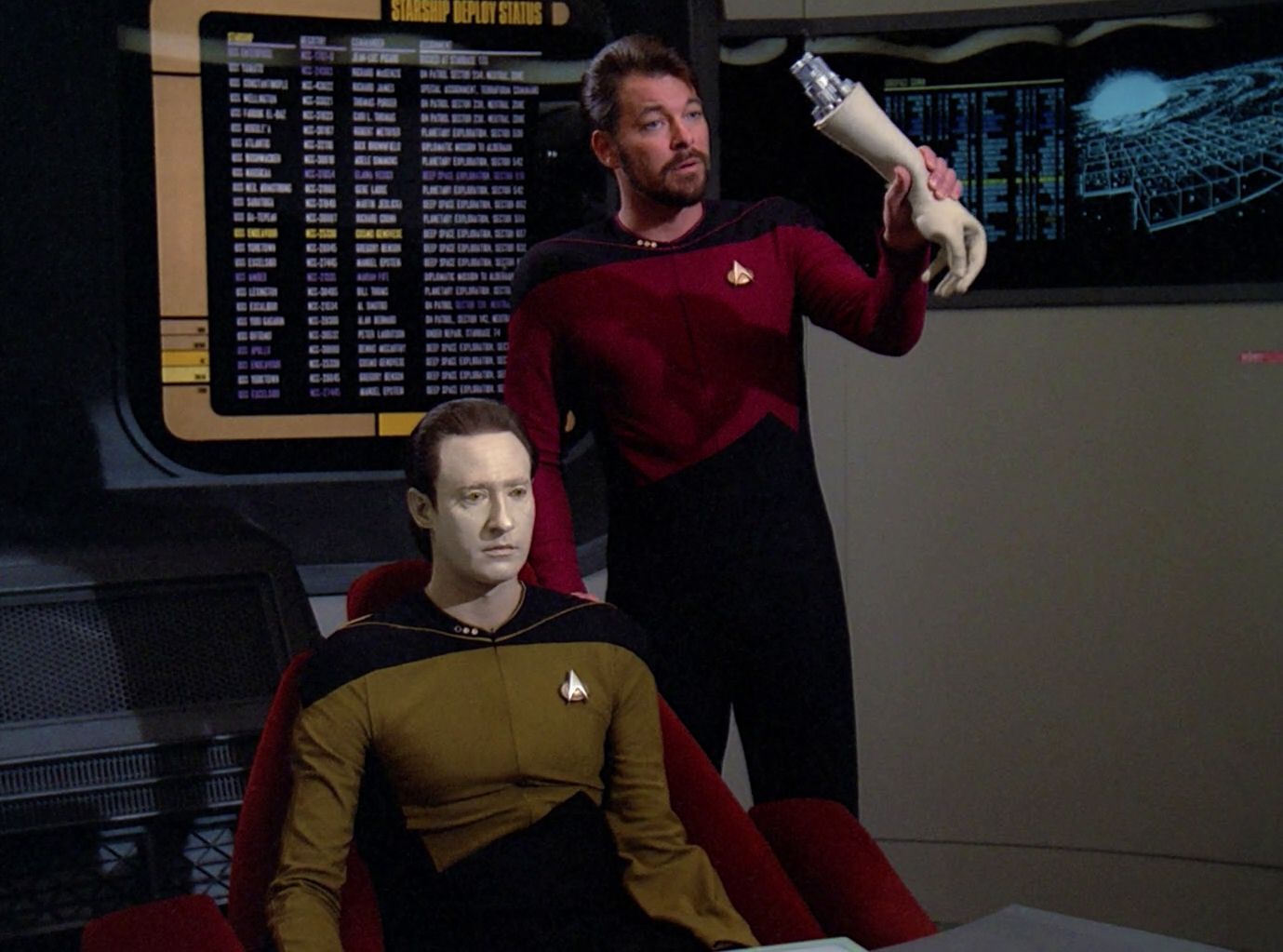
Okay, I'm going to get the most obvious plothole out of the way - In the first episode of the second season, Dr. Pulaski notes that Data's Starfleet service record states that he is alive. Because of that, the events of this entire episode should never have been an issue to begin with... he can't be determined to be property if he's alive. But I for one am glad that they forgot about that conversation. It was a topic that kept coming up indirectly like when they wrote Data as assuming that he was chosen for dangerous mission because he is an expendable machine. They'd even directly brought up the rights of an android before when Dr. Graves claimed he had more of a right to exist than Data because Data was a machine. Even though he obviously couldn't have made it this far in Starfleet if he weren't thought of as a sentient being, the matter still needed to be addressed on the show, as a kind of closure to all of the hinting around that the writer's did in regard to Data's nature from the very first episode when Riker expresses concern with the fact that he is a machine. It would've been harder to allow the character of Data to grow without this episode in place.
The first poker game! I often repeat the phrase, "they didn't know how popular this would become," but in this case it's the truest statement. Not only did it bond the characters and give us many humorous moments, it was also one of the most effective set-ups for many shows and if you put them all together, you can see just how the characters change and grow throughout the series. Another "first" that O'Brien is involved in, although I don't think he ever turns up at another one. Data's first experience with poker was used later in this episode to debate with Commander Maddox personally about how studying his technical design may not be enough for Maddox to safely experiment with him without doing irreparable damage.
But first thing's first. They're doing routine crew rotations at a star base when Picard runs into an old friend and adversary who is the head of the new JAG office. (Judge Advocate General) The two things that bother me are the way time was wasted on their history together. She unsuccessfully prosecuted Picard once and although I could buy that they have a mutual respect, it's not without the silly flirting that the writers thought was so necessary to every episode at the time. I'm also bothered by the fact that she was talking about "making law." That's just so typical of how liberals in this country think... That the Judicial branch alone makes law because they use the Supreme Court to nullify the three branches of government system and overrule and marginalize the sovereignty of the states so often and just force law down the country's throat. It's fully supported by those that wrote this as you can see when she speaks of making law as an admirable and noble pursuit, but as the episode progresses you can see just how dangerous it is in the way they pick apart poor Data and the implications that would go along with him being declared property. Liberals are so stupid.
Anyway, we meet the overzealous Commander Bruce Maddox who has studied all of Dr. Soong's work and is completely obsessed with studying Data. He designs to take Data into his custody, dismantle him and attempt to create more androids. This is a really good reason why this episode needed to happen. Even though Maddox is portrayed in a slightly "mad scientist" kind of light, the fact that Data is supposed to be a feat of induplicable engineering and perfectly unique is something that somebody would've realistically taken an interest in long before he made the rank of Lt.Commander on a starship and had free reign to live his life as he chose.
There are so many good points made in this episode regarding human rights and slavery. They determine that Data is property of Starfleet so he cannot refuse to comply with Maddox's experiments. It's a mark of how new the show was and how new all the characters were to each other that the writer's even considered writing Picard as seeing some reason in his experiments doing over all good. But it was just a launching point for more wonderful reasoning and debate. I would love to go over every point and show every video clip, but that would take all day. I'm just reviewing here, so suffice it to say that the many back and forth exchanges that went on throughout the episode is what made it a great episode.
It's not until Data chooses to resign from Starfleet to avoid the problem altogether that Maddox cries "mommy!" and forces a litigation over the matter. Because Captain Louvois is understaffed she can use enlisted officers as advocates choosing Picard as Data's advocate and Riker as the prosecutor. A little simplistic and with obvious dramatic intent, but it worked very well in this episode. Riker basically couldn't refuse because without the trial she would've had to find in favor of Maddox by default.
The trial was the best part of the episode and I wish so much that it could've been longer. If they'd trimmed some of the history of Picard and Louvois at the beginning they could've put more into the trial. It's not entirely credible as a legal procedure, but neither are a lot of Law and Order episodes. Both sides of the issue are handled brilliantly and fairly. This is a demonstration of some of the first truly excellent writing that they did. And no one can fail to feel as sorry for Riker as when he does his job as a prosecutor so thoroughly that Maddox's side of the argument doesn't even seem evil or unreasonable to a certain extent. The scene where he learns of Data's off switch and smiles in triumph because he'd found what was certainly a winning piece of evidence and then his expression immediately becomes one of sickness and sorrow because he's knows he's destroying a friend is one of Riker's best moments to my mind. Great acting by Frakes.
They also take a piece of that horrible episode The Naked Now and use it for some good. It added depth to Data that surprises those who are determined that he is merely a machine to learn that he had a relationship with a woman. Although in the aforementioned episode it was a crass, one night stand, it is indicated here that they perhaps did speak of their brief encounter and had come to some kind of mutual understanding of what it meant to them in each of their lives. And that Data must have confided in someone after her death in order to understand it all further. It was respectful to the character of Tasha; more respectful than the death they wrote for her. And it's just one of the many tools of Picard's strategy of such a compelling defense that would sway anyone in his favor.
I have to conclude with Picard's closing arguments that follow his cross examination of Maddox. If spoilers are what you're worried about, then you shouldn't be reading reviews anyway, lol. Like I said... it starts to float away from the reality of what a legal proceeding would be like, but it's a fantastic climax with a lot of heart and a sense of finality on the subject of Data as a machine.
This gets the highest rating I've given yet in the first or second season: four and a half of five stars. It really is one of the best episodes of the series.
In surfing for other videos it gives me a lot of suggestions for Star Trek related videos and I found a few I liked
This first one is a tribute to DeForest Kelly. He's my favorite TOS actor and I loved Bones. I'd never seen this until the other day. Very sweet.
I've known about this one for a while... Brent Spiner recorded an album of oldies. This is my very favorite. And he's got a great voice. Incidentally, that's probably him impersonating Patrick Stewart in the bridge. He can do that.
This is 14 facts about Star Trek. Of course, I knew most of them, but this guy goes into the details of some of them, and they never stop being cool.
Finally, an interview with Jonathan Frakes and Marina Sirtis... this is fun and funny. It just popped up out of nowhere on the side and I decided to watch it. It's really neat how close the cast of TNG was.
Showing the Geoffrey Rush love today! It'll look like a bunch of Geoffrey Rush clips threw up all over this post... I love him to pieces. He's a great actor and even though he's won many awards, I still am apt to call him underrated. I don't think a lot of people who just know him as Barbossa from the Pirates movies really understand how versatile he is. Good guys and bad guys and those who fit into both categories at the same time; caricatured and straight up; serious and comic; he's really a well rounded performer. So let the love begin! The first video is a compilation of several things... some of which I haven't seen.
But, of course, there's more Barbossa...
Here's one I bet everyone forgot about...
This movie didn't follow the book very well, but they picked a couple of great leads for Jean Val Jean and Javert..
I didn't realize that Peter Sellers was a total weirdo until I saw this movie. I'm sure some of it is dramatized, but my goodness did Rush ever nail the impersonations of Sellers' characters. Unbelievable acting!
And one of the best characters ever... Lionel
Here's him winning an award for Shine. I've never seen it.. it doesn't seem like my type of movie... but it's just sweet to watch. I'm sure he earned it. Especially when I see who he beat out that year.
This episode tests my patience a little bit. It's like a conflict of good and bad writing. You could see that effort was being made but it was still being restrained as well.
I didn't care for the target range. It was a little better later on when they had Guinan and Worf practicing. Probably because the effects were a little better. This was too colorful like the place where Wesley was supposed to be taking his entrance exam for the Academy in Coming of Age. And it seemed empty. And although I know the captain needs to practice as much as anyone, it just seemed weird for him to be there. Perhaps it's because it seemed weird for him to be dropping hints to Riker to sign up to be an exchange officer on a Klingon ship. Almost like a father putting pressure on a child. I just wasn't buying the motivation. This part of the plot was kind of thin.
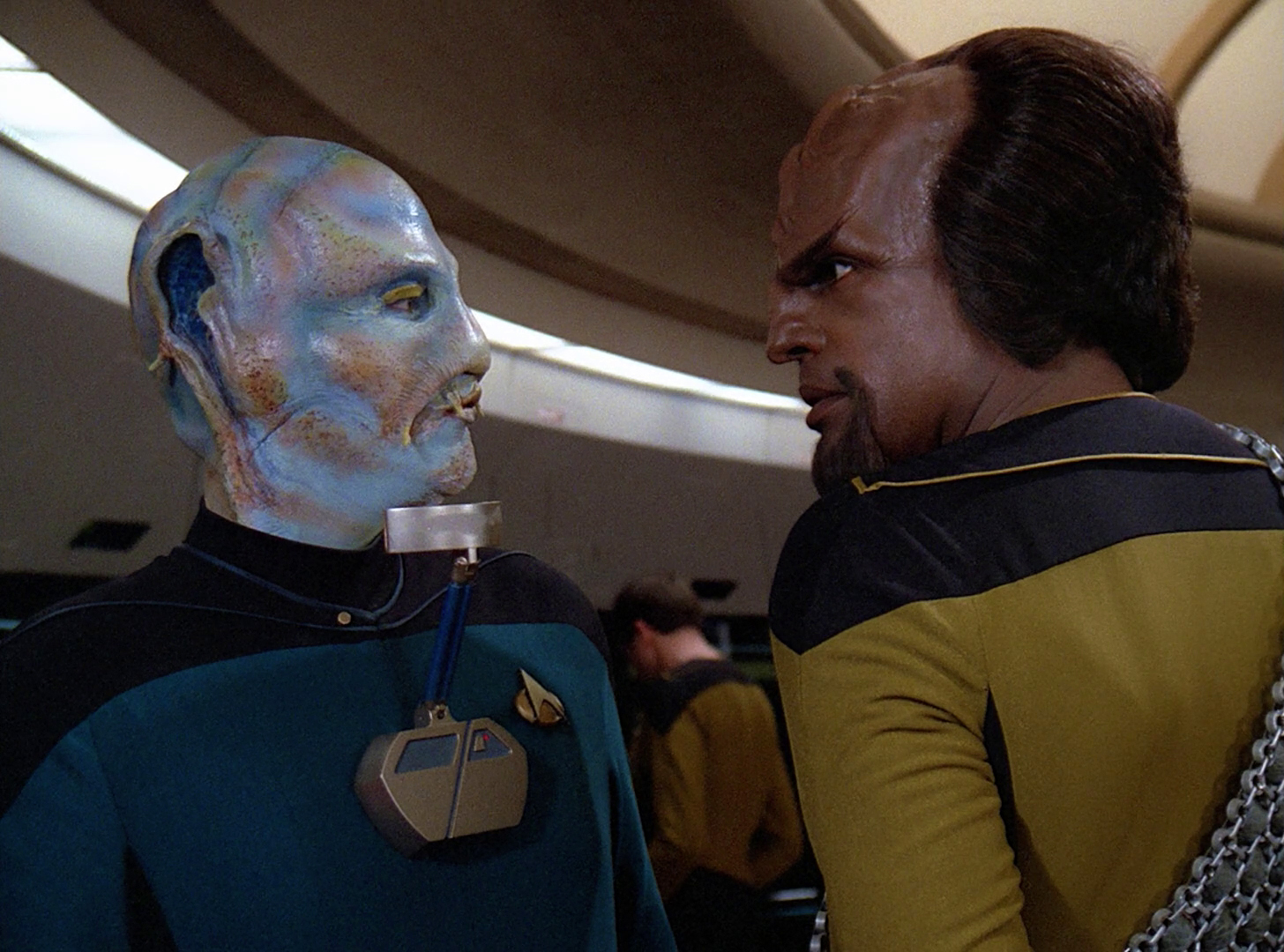
I'm not sure when having foreign exchange students in America has been most popular, but I know it was doing very well in the 80's. People from my small hometown area hosted a couple of different students that came to my high school. Anyway, I can only think that since these first two seasons were trying really hard to pander to young teenagers, that that must have been some of the motivation behind writing this episode. The enterprise also gets a temporary new crewman. You think it's the Benzite named Mordock from Coming of Age. Wesley thinks so too. But it's actually a Benzite named Mendon. It turns out that this particular race of people... really do... all look alike. You can infer a facepalm with that. I just don't know what was going through their "liberals aren't racists" heads sometimes.
Anyway Benzite means of operation are very different from the Federation's. Mendon gets on everyone's nerves by over-zealously suggesting improvements to the systems. Benzites also expect to have solutions to their problems before they're even reported. This ends up making everyone aggravated with the poor perfectionist, especially after he finally reports a bacteria that had been eating away at the hulls of both ships well after they'd parted ways, putting an interesting twist in the plot.
And the plot wasn't really a bad one. I just don't understand the time frames I guess. Worf gives Riker a transponder in case he needs to get out of there explaining that promotions happen by assassination of the captain often and it's perfectly fine. Okay, got it. It makes sense because Klingons are more aggressive. And when he gets over there, it starts out pretty good with Riker being challenged by the second officer and winning his place as an officer aboard a Klingon ship. It was great and fun to watch. He had to be as brash on the Klingon ship as Worf had had to be docile on the Enterprise.
He gets to learn that they prepare their food a little differently than the dishes he practiced on in Ten Forward for some nice, humorous moments. And it was somewhat of a time killer since the story was a little too simple as always. And they hadn't committed yet to the idea of Klingon dishonor as Riker bonds with one of them telling him to contact his dishonored father. But, still, there was a real effort being put forth here to develop Klingon culture. These parts were all part of the fabric that was woven for the Klingon culture as the show advanced, even if they were never brought up again. It was important and meaningful in the long run even though it was treated comically at this time.
Where this episode loses me is the attitude of the Klingon Captain. The Enterprise tries to come back to warn them about the hull eating bacteria and Kargan goes off the deep end. It's like, they were trying to develop the Klingon culture because they're not a nemesis anymore... but they still wanted to write them off as the Neanderthal war mongers of TOS at the same time. It was breaking Roddenberry's own rules (no wars with Klingons) because they still couldn't think of anything else to write about. And it's very confusing when you consider sixth Star Trek movie when it came out a couple of years later... the seeds of the alliance of the Federation and Klingons were sowed in that movie which took place while Kirk was still alive and running the Enterprise. So all of this time has passed and also there's a Klingon serving aboard a Federation ship, not as an exchange experiment but an enlisted, accepted, and trusted officer... however, Kargan's behavior would make it seem like the treaty was signed only a week or a month ago. The Enterprise is coming back? It must mean sabotage! Cloak the ship and prepare to destroy them! War! War! Grr! Klingons smash! So quick and eager to abandon any treaty that may have been in place for what I assumed must be years now. They just had such a hard time letting go of the old style that it kind of tore this episode into two different and disagreeable directions.
The end is wonderful. Riker butts heads with the captain on refusing to betray the Enterprise, but still tricks him into moving in close enough so that the transponder Worf gave him would work. He gives it to the captain and he is able to assume command without killing the captain - an intelligent way to work around that tradition. He continues in Klingon fashion by demanding a surrender of the Enterprise which Picard complies with to legitimize Riker's position on the Pagh. (But what about the alliance? I don't know... better not think about it too much...) They arrange for repairs to be made to the ships. It's clever and fun. And when Kargan returns, Riker gets himself dismissed from the ship in Klingon fashion which earns the captain's respect. More really good culture development that just clashes with Kargan's behavior up to that point and ends up not making a lot of sense. Sometimes I wonder if I'm the only one that notices these things.
I'm really torn about how to rate this one. The creative writing parts make me want to give it three and a half but the way they were still keeping the Klingons in the 23rd century makes me want to drop that to just three. I think I'll have to go with just three on this one. They did okay with this episode, but they can, have, and will do so much better.