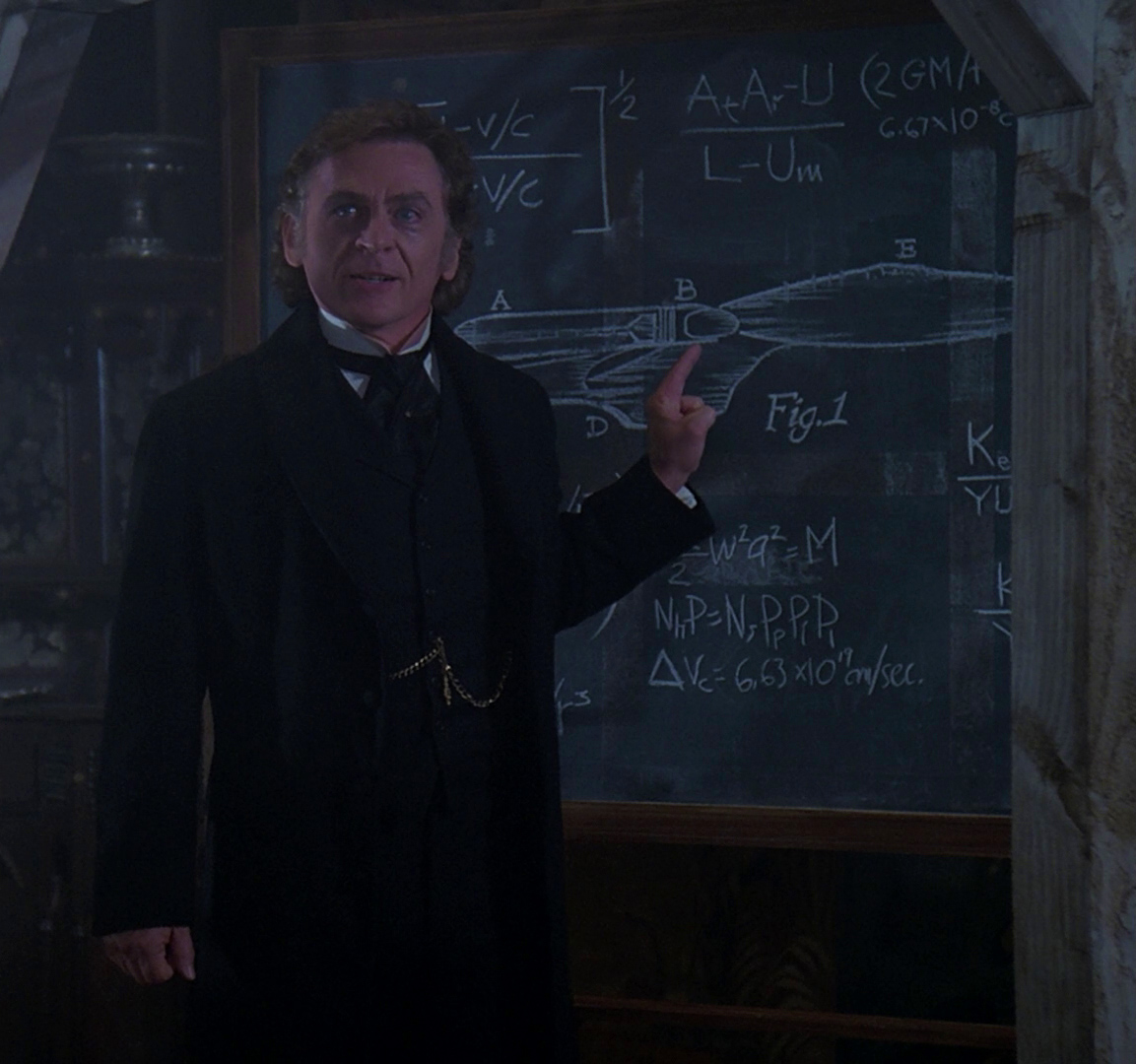
This is a good episode. This is also a frustrating episode because it's hampered by the flippancy common to the first and second seasons. I want to just scream at certain points because I really like the concept and most of the episode in general.
I also have to tie in a point that I was making in the last episode regarding aliens looking human all the time. This is one of the cases where it's not that big of a deal. If there is real substance in the episode, you can get away with human looking aliens because there's too much going on for a person to be too critical. The Enterprise has to transport a famously successful peace mediator to a planet where warring factions are ready to sit down and discuss a treaty. Finally the confrontational parties are on one planet instead of two, making the scenario more accessible to a thinking mind. They spend a lot of time getting Riva from his own place too in order to introduce the wonderful idea of this deaf mediator.
Wonderful, not because he's deaf, but because of the way he communicates. He can sign and read lips, but the most creative part was his "chorus" that traveled with him and spoke his thoughts aloud because he had a fine tuned telepathic relationship with them. He expects to be directly addressed even though other people are giving his answers. This is such fantastic writing. I love it so much. I was disappointed in the distribution of his personality among the three interpreters. They seemed to have broken it down into intellect and emotion with a third and leading voice that harmonizes the other two. It just seemed a little underdeveloped since the "passion" personality, voiced by the nice looking young man, was only used to hit on Counselor Troi and not much else.
That's really the most frustrating part of this episode. They spent too much time playing around with what could've been a much more complex story. Back in the TOS days, fast paced and simple stories were necessary for the audience of the time. Save the day, get the girl, no time to really think about things. In TNG, there didn't need to be romantic entanglements or sexual tension in every episode just to keep people interested. There was no need for anyone to "get the girl" or for the girl to be getting anyone either. Riva is attracted to Troi because she's telepathic and he can communicate better with her alone than he can with others. It's understandable, but it was also a slight waste of time and, like I said, a poor use of the creative aspect of a deaf man having a chorus to speak for him. Passion is also temper and elation. Creativity and drive to succeed. Not just libido. But that's more of the juvenile writing of the first couple seasons coming to the surface again.
The actor who plays Riva is deaf in real life so you also have a small subplot regarding Geordi's blindness. Suddenly after an entire season we find out that a doctor can probably fix this with ocular implants and he must mull over a decision to either go with that or remain the way he is, living with his disability. I get what they were doing here. Riva was living with his disability too even though he could've sought medical attention, and both men felt stronger and more unique that way. It's a nice message, really it is. I just felt it took away from what could've been much more exciting and cerebral in the show. But TNG wasn't ready for that kind of thing yet.
But the short, exciting bits make it worth watching. They go down to the planet to try to begin the peace negotiations and things go horribly wrong. One of the men who is part of the darker clothed delegation has second thoughts about all of this and fires on Riva. Riker saves Riva but the chorus is killed. It wasn't a real surprise, but it didn't make it any less appealing or less intense for the viewer. I was heartbroken for Riva.
The time they spend developing his character may have added to the story's need to be simple in order to wrap it up in an hour, but it also makes his loss huge and believable. When he starts freaking out, it's believable and it leads to some really good scenes where everyone must try to figure out what to do about this tragedy.
They go through a couple of solutions too instead of having the answer right away. This is an excellent early demonstration of the problem solving and team work that is honed to perfection in the show throughout the years. Use Data? He can interpret Riva's signs but he's too much of a machine to convey empathy. Use Troi? She's not an experienced diplomat, doesn't have all the details of the situation, and is not as in touch with Riva as his chorus was even though she's telepathic. No, neither of these solutions are acceptable.
The final solution has an after school special ring to it. Turn a disadvantage into an advantage. I don't mind it's simplicity because it really is a good lesson to teach and the idea they come up with makes for an interesting story by itself. Riva bravely goes back to the planet alone. In teaching the opposing parties how to communicate with him by signing, he will also teach them to communicate with each other. It sounds like something that is too simple and easier said than done than it would be if it was a real situation, but it's still solid writing because they leave it opened-ended instead of indicating that everything works out perfectly. Perhaps it did take a long time with many dangerous back-steps. One can imagine the idea to be as simple or as complex as they want which involves the audience and makes a connection people instead of just being entertaining. Very nicely done.
Yes, this was one of the best episodes of this season, I think. And I've always thought this is a character which should've been brought back and followed up on. Especially with the turn the show took in general leading into DS9. After all, they add a throw away line in this episode about how Riva helped to negotiate treaties with the Federation and Klingons. The guy was obviously special. But they never bring him back and it's a shame.
It gets four stars. I can't go any higher because it's still just a little too immature in certain moments, but if I was trying to sell someone on watching Star Trek and I only had 10 episodes to do it with, I think this one would be one to consider.
When that guy from the videos yesterday was making his top 10 favorite Star Trek actors he mentioned a few other things that Patrick Stewart had done, but not these two which I particularly like....
Scrooge in a 1999 version of A Christmas Carol.
And MacBeth from 2010. I don't like it that it took place in a modern time, but Patrick Stewart made it worth watching anyway.
I don't know who this Enchantment of Eternity guy is, but I got to browsing some of his Star Trek lists this morning. I don't agree with some of the things and people he lists as worst or his least favorite, but I find I respect his opinion for three reasons. First, he doesn't include the reboot crap in his lists. Secondly, the place I normally see these list at, Mojo, just panders to what's popular without any real thought put into most of what they list off. Which brings me to reason three, this guy is a real Star Trek fan. He's seen all of all 5 series and his opinions are informed for it. I gave up on Voyager, didn't get the chance to see most of Enterprise, am missing large chunks of DS9, and it's been, like 30 years since I've seen TOS (although I have caught a few on BBCA lately) so my Star Trek opinions are centered around TNG. I enjoyed this guys video and it makes me think I really need to brush up on all my Star Trek series... get them all watched too. Lol. I also need to make some lists of my own.
First are his favorite characters. He also includes least favorites and honorable mentions in all of these videos.
Next are his favorite actors, taking their other works into account.
I've been in the mood to write on my own story or book again. A lot of us that blog fancy ourselves writers and we all want to write the next big book or series. Obviously, my interests include science fiction and fantasy and I write stories in my spare time. I won't bore everyone with anything current for a couple of reasons. Firstly I'm shy about letting people see my work. I'll probably never make it like that.. lol. And also you don't just want to put material like that out on the internet. It could be stolen and reworked and a person could lose any small chance they ever had.
I will share a couple of my certain failures with you however, mainly so I can share why they are failures. I have always written. I was writing before I could even write. I'd draw pictures and have my mother write what I was wanting for story captions. I've always written even when I was just drawing fan fiction of a favorite cartoon and knowingly stealing ideas from movies I'd watched. I never intended to share that stuff anyway. But when I started to seriously start writing, I would put a lot of work into what I was doing just to realize that it had all been done before and my heart would break. You see, I hated reading as a kid. I don't know if it's the reading I hated so much as it was being made to read anything. I was more interested in playing and watching television. I read a little, but most of my reading was assigned to me from school and I rejected it. So I was embarrassed when I was writing a story about time travel... the idea that there were pockets of time that people would fall into like small ponds for example.
Kind of like the wood between the worlds in The Magician's Nephew which was utterly brilliant. I knew when I read it that my idea was not only unoriginal but that that this idea was superior. And that's just from a classic that I missed while growing up. I read Treasure Island after I graduated high school and it was the book that hooked me on reading. I started devouring classics as fast as I could get a hold of them but it wasn't fast enough.
Then there were modern books that I didn't get a hold of fast enough. I was working on a story about an evil magic bad guy that wanted to take over a couple of kingdoms. He was thought to have died 50 years previously but had some kind of magic ritual that kept him alive and he returned, to everyone's horror.
Obviously it wasn't the idea for the Harry Potter series, but it was very close to the idea of Voldemort. I had one Harry Potter book at the time, the third one, and it hadn't gone into much detail about Voldemort since it was more about Sirius and Pettigrew in the end. It was before the movies started being made so although I'd intended to get the other books, I'd just been putting it off at the time. Like I said, it's embarrassing. And all because I got a late start reading and I wasn't keeping up in my favorite genres.
I think the idea I have now is fairly original. Of course, there's not much out there that's truly original anymore. Even the Harry Potter series borrowed and tweaked previous concepts. But I think I'm finally onto something. I've been fiddling with it for a while now. I'm not very disciplined. It just comes in moods and I've been in the mood lately. So some posts between Star Trek episode reviews may be short until I lose interest again.
This guy was Roddenberry's first choice to play Riker. It's easy to see why. He really is adorable. The Enterprise picks up this Captain Okona who is a very Han Solo-like rogue to assist him with repairs to his ship.
He proceeds to charm everyone on the ship and pick up a couple of different lady officers in the process. His charming, swashbuckling, lady-killer personality was a little over the top and overdone. But I don't mean the acting. He played it just right, it was the character of Okona who is almost a little too much at times.
He also sparks the sub plot of inspiring Data to study humor. I actually preferred the sub plot in this episode. Data was the "Spock" character of the show. Although Spock would often claim not to have emotions, he did and they sometimes emerged. Although he claimed not to understand human humor, he often had a witty retort on hand that was undeniably humor. Data is genuinely incapable of emotion and although we see Data getting laughed at a lot up to this point for unknowingly saying something funny, we never see him learn from it. Character development is so important. This is just a small piece of Data. As the show progressed, he needed less humor references explained to him even though he didn't have the ability to find them amusing. He didn't stay stuck in his own stereotype forever, and it's episodes like this that really help that process.
He gets his advice from a random Holodeck stand up comic played by Joe Piscopo. They originally wanted Jerry Lewis, but Piscopo gets an imitation of him in there, so it all worked out. He tries to school Data in comic timing and delivery which is often as important as the joke itself. It makes for some wonderful and funny scenes as you watch the humor escaping Data at every turn.
As to the rest of the story, you find out that the outrageous Okona is a wanted man on both of the planets that the Enterprise had just happened to be passing through when they found him. The planets are at peace with each other, but it's a shaky peace, so naturally this causes friction since each one wants to claim him. One leader wants him because he had allegedly stolen a jewel which was their national treasure and the other leader wants him because he's sure that he's the father of his daughter's child.
I realize they didn't have the best budgets at first, but they had more than they did in the 60's. I'll bring up Roddenberry's complaint that he wanted to see new aliens, yet most of the time the aliens just looked like humans as it was in TOS. Once in a while okay. But too much repetition of this phenomenon added a bland feel to the show. He should've given up on the Ferengi a little sooner and started throwing out other kinds of aliens out there to see if they could find something intriguing instead of just humans in funny clothes.
Wesley hadn't done much this season, so they use his innocence to make the lovable rogue decide not to keep running from what seemed to be his responsibilities. Just more misuse of poor Wesley
In the end it turns out that Okona is trapped between Romeo and Juliet. Not a surprising twist, but not disagreeable. Benzan, the son of the other leader is really the father of Yanar's child (the other leader's daughter) and he took the jewel himself to give to her. Okona turns out to have been the go-between for the two young lovers for months. Of course, being the 80's the girl has to get in a few whiny lines about not wanting to marry anyone because she's embarrassed and agitated at Okona and Benzan both. But, alas, the love of the children melt's the fathers' hearts and Okona is free to go. Aww. That's the happy ending.
Data's story ends in disappointment however, as he realizes that he's performing comedy to a holodeck audience that will laugh at anything and concludes his experiments to be a failure. This is another clever example of how the holodeck would really work when it isn't going haywire, making the weapons really dangerous, and bringing people to life. And it's a building block in his character.
It's not a bad episode, really. Sappy but likeable. An important developing point for one of the main characters and also a good handling of two plots in one episode. It was just not the best effort ever put into a one-off episode that is never connected to anything else. Three and a half stars.
After a shaky start, we move onto a "just for
fun"episode.And not a moment too
soon.It's good to break up the momentum every now and then. Whether things are going badly like they had been or even when things are going good.
The Enterprise has some down time so the characters get to
engage in recreations.We never see
Geordi's interest in creating model ships again.However, they take the opportunity to expand
on Data's interest in Sherlock Holmes, which he is first seen dabbling in
during the episode, The Lonely Among Us.
This situation is more appealing and visually satisfying
than Captain Picard wanting to dress up as a gangster era detective.On the whole there are more references to
Dixon Hill than Sherlock Holmes, but I think Data's Holmes wins in the area of
fun on the holodeck.It's also appealing
to a 20th century audience in a way that The Big Goodbye wasn't.It begins exactly as one would think.Geordi takes Data to the holodeck to play out
a Sherlock story, but Data already knows the ending.It's a relatable situation to anyone who has
at least one friend in their group that is good at spoiling the fun in some
way.
I think what I like most about the holodeck episodes is
that it's a great way to get characters out of their normal uniforms and put
them in more familiar clothing without having to commit to a time traveling
story.It's one of Roddenberry's good ideas
that he couldn't develop in TOS, so they had to have some strange episodes that
included not only time travel, but planets where the aliens were just dressed
like normal people - which was always quaintly charming in the old series, but
would've been completely absurd and unacceptable in the new show.The holodeck was Roddenberry's greatest idea since Star Trek itself. I have to admit that he could really knock it out of the park at times.
Through Geordi, they also manage to make the point that I
was making the other day about the dynamic between Pulaski and Data.In trying to mirror Spock and McCoy, this
relationship was more delicate and Pulaski's chiding could be considered
bullying in comparison to McCoy just sounding jealous at heart of the superior
Spock.They note that the observations
that Dr. Pulaski makes about Data not being able to perform deductive reasoning
on his own without the complete works of Doyle to assist are unfair.
However,
that doesn't stop Geordi from trying anyway.
He programs the holodeck to create an adversary that can defeat
Data. In order to beat a machine you need to be a sentient being of course. And here is where everyone in the
Star Trek fandom happily leaves any pretense at reality. How can a computer create a sentient
being? We don't know and we don't care. It's
just a good, fun story. They make a
monster that is aware of the Enterprise and aware that the person who is
pretending to be Holmes isn't really Holmes.
You also see the first attempts at fixing the concepts from previous
episodes. The holo-characters can't see
Data's strange skin and Geordi's visor because they aren't real. This was a flaw in The Big Goodbye. It's all perfectly normal to all the characters
until the problem with Moriarty occurs.
And even his new knowledge doesn't call attention to the obvious. He knows Data isn't really Holmes but he
doesn't know why and Geordi's visor doesn't concern him at all.
Moreover, they made him charismatic.He's still deadly but his focus has changed
because he now knows he's not "real."In The Big Goodbye, the characters are explaining to the holodeck
figures that they aren't real because of the safety accident and it's all very
awkward and silly.The characters have
no reason to care if they're real or not and shouldn't have the desire to do
anything but play out the Dixon Hill program. This episode lends a little depth
to the safeties on the holodeck going haywire.Moriarty became self aware...oops.
But at least now the danger becomes a little more
intelligent and better science fiction.Now that he knows he's a literary character he's no longer interested in
defeating Holmes or being a crime lord in London.He just wants to see the world that he knows
he's now a part of.Perhaps he had
nefarious intentions for this world as well; after all he's still Moriarty.But the newness of it all has him in awe and
it makes him likeable.It gave him a
sympathetic quality even though he was still a villain by nature, and grayed
the lines of black and white on what was the appropriate action to take.It was good writing.So he takes the whole ship hostage in order
to get their attention and his release from this holodeck world.
In the end they reason out that it's possible for Moriarty to
survive outside of the holodeck because that the technology wasn't sufficient
yet.Originally, Picard and Data make
that determination privately and are not honest with Moriarty on this point.They scrapped that idea because they didn't
want Picard and Data to be deceptive and it was a good move.They explain it to Moriarty and he agrees to
wait in their memory banks.It's kind of
a cheesy ending, but it's not entirely out of the realm of the possibility with
a character like that who, although evil, was also a refined gentleman who had to have a lot of patience to work a mastermind's intricate plans.
It's not a great episode and it has it's wasted moments like dressing Worf out in costume for no reason at all, but it's an improvement on
previous ideas and it was also a lot of fun.Moriarty's interaction with Pulaski was charming. His character was believable. And seeing Data finally
being able to prove his abilities at deductive reasoning after Geordi's request
is granted is just plain entertaining.It also had an open ending which they do follow up on later although I'm not sure they planned to.Normally I'd give an episode like this three
and a half stars due to an overall lack of complexity, but it really was fun
and it seemed to project a sneak peak of the greatness that the show would
develop in the following seasons, so I think I can go with four stars on this.