Blog Archive

Saturday, March 26, 2022

Top 10 Favorite Book Series


Top 10 Book Series of All Time
Criteria can be any series by the same author(s) and a minimum of five books that you have read.
Personal note:... I won't be following the criteria to the letter. There will be a few trilogies in my list. 


#10 Dragon Riders of Pern
Author: Anne McCaffrey
30 books in the series
Books I've completed: 5
This is a sizable series and a very good one. Not continuous, it contains several trilogies and stand alone-novels. And in my experience so far, I've noticed the trilogy sets also shift focus within - the main character of the first book is often not the main character of the last, which is an interesting approach. But, McCaffrey is a a wonderful writer who created a world that married science fiction and fantasy elements surrounding the lives of people on a planet who need dragons help protect them from a deadly spore-fall that occurs when the planets in their solar system pass each other in a certain orbit.
The first trilogy, Dragonriders of Pern, containing Dragonflight, Dragonquest, and The White Dragon set up the concept beginning with the story of the newest rider of a queen dragon and finishing with the struggles of a land holder turned rider to the backdrop of the world building as pertaining to the dragons and the spores.
But the first Pern book I read was the first one in the Harper Hall series, Dragonsong which focused on a secondary aspect of life on Pern, the harpers who kept the historical records of their society in songs that are taught through the generations. Dragonsong is about one girl's journey from obscurity to a career harper. But her story seemed rushed in the second, Dragonsinger, and didn't have a solid tie-in with the overarching premise, although I loved the fire lizards. So I skipped the third one, Dragondrums, which had a new main character that I don't think I'd like anyway if his appearance in The White Dragon is any indication of his personality. But the overlap of the two sets is clever and I like the fully finished lead character from Harper Hall as she appears in The White Dragon.
At any rate, this is a great series of books. Will I ever get through all of them? Remains to be seen. But I do recommend them.
Tagging, Jaycee Caramsalidis, who is also a big fan of the Pern universe.


#9 Sherlock Holmes
Author: Sir Arthur Conan Doyle
5 novels and 56 short stories in the series
Books I've completed: almost all of them
The Sherlock Holmes series is a little different and probably not thought of as a "series" since, apart from the Moriarty material and the occasional mention of Watson's wife after he's married, there's no real continuity in them. They're episodic. But they're so compelling. Mystery is another genre I like although I don't have as many and it turns out that, as with the supernatural/thriller genre, the short story is a really good format for it. I like the slower pacing of a novel but it's very talented and creative to create misdirection in such a limited narrative. The stories were smart with interesting twists and became the standard bearer of the genre. You can see Doyle's change in style from the first novel, A Study in Scarlet in which he switches the POV in the reveal at the end to later works where he refines the technique to explaining his brilliant deductions to Watson. They range from deadly intense to comical misunderstandings. And even though there are some repeated openings over the span of the series, each story remains unique and, even after binge reading several in a row, unpredictable I think. I love to read and reread them. The pictures are just various novels. Jaycee Caramsalidis is not a fan, but this definitely meets his criteria. 


#8 The Inheritance Cycle
Author: Christopher Paolini
5 books in the series
Books I've completed: 4
I'm actually surprised by how much I really liked this series. My first time through it, I noticed almost exclusively all of the influences behind it and was tempted to call it unoriginal but after another read, I noticed all the little details that made it unique. After all, there is nothing new under the sun, and this is yet another variation on the fantasy theme. There's a nice balance of action, problem solving, as well as humor and tragedy. All the characters likeable and the way the story is paced keeps you interested and wanting to find out what happens next. It also has a beginning, middle, and definite end. I'm a big fan of closure. I like the episodic types of series that don't have an underlying theme and the grand series that are layered with stories within stories and can carry on over several decades. But part of me appreciates seeing a final payoff for all of the work and suffering the characters go through. And bonus points if it's not a perfect, happy ending but adds depth with some bittersweet complication. This series went with a more complicated ending while tying everything together nicely. I found it satisfying. Just the kind of series I like to reread for comfort food. The fifth book is an extension of the series. I think it may be the start of a sequel set, but I don't think it's done well and I'm not sure if more are planned. It's on my list of things to try out. That's a possible downfall of having a clear and definite ending... people aren't as forgiving with extentions. But, we'll see. All in all, it's not bad for a modern YA series.
Another that Jaycee Caramsalidis probably wouldn't care for, but variety is the spice of life.. 


#7 Miss Peregrine's Peculiar Children
Author: Ransom Riggs
7 books in the series
Books I've completed: 6
To be honest, I fell in love with the concept of this series first. Riggs took a bunch of creepy looking old photographs and built a story around them. It's an exercise in creative writing that just makes me so happy. It's the sort of thing I'd do with a cousin when we were kids. The creepy pictures led to a supernatural story. Not normally my type of thing anymore and I didn't find them terribly frightening, but the pictures were integral to the process and having them scattered throughout the novel for visualization just made me smile. It's different than placing artwork in the pages because the author had to spin the narrative around them to make it work instead of drawing his own vision of characters and settings. Of course, as the series went on the story became more complex and fleshed out so there were fewer pictures and several had to be altered to fit into the events. But the writing and the story turned out to be solid on its own so the pictures became just a clever contrivance that made the books unique and fun. Fun enough for me to forgive any plot holes or continuity issues that arose between the two trilogies that the series is composed of. And I had a moment at the beginning of the second trilogy where I was, as mentioned in my previous entry, a little put off with the extension of a completed story, but I stuck with it (for the pictures ๐Ÿ˜‚) and it turned out to be a addition. Along with the first trilogy and the sequel set, there's a seventh book that is a companion piece. Tales of the Peculiar, which I don't think is directly related to the main characters of the previous 6. I got it with my Christmas books and it's in my queue. So, if you like supernatural stories and think you'd be chilled by old black and white photos that fit the story, then this is for you. Probably not for Jaycee Caramsalidis who I will bypass while he's on hiatus. But our overlap in lists will come soon.


#6 The Hunger Games
Author: Suzanne Collins
4 books in the series
Books I've completed: 3
The last two series came as a delightful surprise to me and this one did as well. I kind of went along with the crowd when I tried the first book and was unsure about it. But I was interested enough to try the second book... about 6 years later. After some time passed and I looked at it with fresh eyes, I ended up being hooked and got the third book right after I finished the second. Dystopic scifi isn't one of my usual choice either. But this one is especially character driven. I've described it as a cross between 1984 and Bladerunner. But it wasn't trying to convey a specific political message. It's an evergreen future in which a reader of any political side can see it as the result of his or her opponent. Also the science of the scifi was vague. Instead of explaining how everything works it just gets on with the struggles of the characters within. Not every technology has to be backed up with enough techno-babble to make it believable. It's merely a background to set the mood for the story. Sometimes it's taken advantage of in a critical moment but, for the most part, it's not an antagonist to be defeated, and learning how it all works works doesn't really make a difference. I guess I find it a nice change of pace. Instead of having to keep up with technical jargon, a person can really ponder the decisions made by the characters. Everything about this series is different including a heroine that is reactive rather than proactive. She never chooses her path, but makes the best of her circumstances without compromising her nature. It makes for some very interesting twists. It's a series that can actually keep you guessing after all the years of most stories being forged from the same basic formulas. It breaks a rule or two. Not many, but just enough to make it sufficiently different to catch my eye. I'm a big fan of different. And it's also an engrossing page turner in my opinion. The kind of read that stresses me out and I have a hard time coming back to reality after reading for a while. That doesn't happen often to me and that's why I rank these pretty high. For me it's a series to reread when I have extra time on my hands to really dive in and consume it. The fourth book in the set is called The Ballad of Songbirds and Snakes and I don't know much about it. Seems to have slipped in under the radar. It apparently takes place at an earlier time in the universe, during the 10th Hunger Games whereas the main trilogy takes place during the 74th and 75th Games. But I don't think it's a prequel. It's something I'll have to look into sometime. Last clash with Jaycee Caramsalidis 


# 5 The Deed of Paksenarrion
Author: Elizabeth Moon
3 books in the series
Books I've completed: 3
My first break in the List criteria. Sometimes you only need three books to tell the story. And my, what a story it is. It's pretty standard fantasy fare on the surface, but it's actually quite different. The heroine is a young woman whose goal is to become a Paladine knight, the setbacks and challenges she faces as she moves through a military and trains with elves, and her first mission as a knight. With all series, each book should have its own definitive ending, and these do, but you don't see how all three tie together clearly until the end of the last book and it's such an interesting approach. Because the books are so highly consecrated on the main character's actual life and internal conflicts, everything and everyone around her appear to be just window dressing. But it's actually such a slow and subtle build to the climax that it's pretty brilliant. So it's more like one very long story rather than three separate books. The more books you throw in, the harder it is to pull that off. That's why I had to include this trilogy in a list meant for more protracted series. It's too impressive to leave out. Like so many of the others, it's different. And I like different. You can read it several times over and it always seems like the first time. Highly recommend. Jaycee Caramsalidis would vehemently recommend as well..
 
 
# 4 The Chronicles of Narnia
Author: C.S. Lewis
7 books in the series
Books I've completed: 7
Ah yes, Lewis gets a double dip in my lists most of the time, and so he shall this time. He had a way with words, condensing complex ideas and philosophies into words that, not just children, but non-academics as well. Shown here in the order they were written, it's a series that gets better with each one. I've often noted that The Lion, The Witch, and The Wardrobe reads like no sequels were ever intended. But what an amazing save! They kept getting better with each installment. The world of Narnia was expanded and the characters were refined. Some of the seeming randomness of the first book attained focus in future storylines. Episodic, but connected by Aslan, the books follow a number of different kids as they bounce back and forth from our world to Narnia where they're given tasks to preform and lessons to learn. But they're not only lessons for children to learn, although life would be easier if we could learn them that young. There's actually a lot of content squeezed in these seven short novels. No, it's certainly to Lewis' credit that he didn't need thousands of pages to convey powerful works... It holds true with all of them. The sweet simplicity and sincerity of this series has appealed to every generation since they were published. You had to know this would be here Jaycee Caramsalidis


# 3 Harry Potter series
Author: J. K. Rowling
11 books in the series
Books I've completed: 10
I've written so much content about the HP series because I love it so. A detailed review of every book, all my favorite characters, chapters, and moments. I have no shame in having a YA series this high on my list. I was 22 when the series began; 24 or 25 when I read my first one. So, it's no wonder I took to them since I was at the back end of young adulthood. Still close to my youth, it brought back memories of teenage behavior, struggles, angst, nativity , and loss of that innocence. I often wished that I'd have been able to grow up with them since they really do hit the psychology of these years so spot on. Being an adult, however, and not a teenager like the protagonists, the attraction for me was also their freshness at the very tip-end beginning of the staleness and apathy that would take overtake the creative industries. In fact, some of the most creative stuff was coming from the YA industry for a while. Already there were hints and indications that the entertainment industry was getting tired of trying to foster and harvest originality when it was just so much easier to cash in on the same old, same old. Yes, HP follows a formula, but it's a skeleton that was built wonderfully on with such imaginative additions to the borrowed elements. And it still has some traction with the spinoff franchise. I've not invested in it, but I think spinoffs are a pretty good indicator of an original premise... lots of stories left to tell, centered around other characters. A tree with varying limbs and branches. There are 11 books in all - the original 7 in the set and 4 companion pieces, of which I've read three. Those three were like overflow containers of creative concepts from the original series and absolutely delightful. I haven't read The Cursed Child for no real reason. Just waiting for the right time I guess. I feel like I have to stress that it's the book series that's my favorite. I liked the movies and they were perfectly cast, but, of course, they lacked so much of what made the books special. I just love this series and it's overdue for a good re-read. I guess other things keep Jaycee Caramsalidis young at heart though.. 


# 2 The Lord of the Rings
Author: J. R. R. Tolkien
5 books in the series
Books I've completed: 6
The math is right. I'm including The Hobbit and The Silmarillion in the primary set and the sixth one I've read is Unfinished Tales of Middle Earth. There are several unfinished works and other volumes that the Tolkien estate has approved, like the latest repackaging of the story of Beren and Lรบthien. I suppose if one was to track them all down the numbers would go up. But this series isn't just in my personal top ten list but from a measurable market perspective as well with 150 million copies sold. Admittedly, a lot of those may be purchases from schools for kids who felt forced into reading them as an assignment. I've felt that way too about other books. But that's what happens when you're not just unique for your chosen genre, but you're actually are the original. The theme on which variations will be played on for generations to come. The standard by which the variations will be judged. Tolkien didn't think much of the fuss made about his books. He even referred to his fans as cultists. But, I don't think he really understood the impact it had on readers. Or what a wonderful idea it was to spin the age old stories of good versus evil and the hero's journey in that way. Or how that idea was malleable enough that it could inpire so many other writers to augment the basic concept to continue the influence for better in some cases or worse in others. His writing has become so appreciated by so many. And the recent revival through the Peter Jackson movies have reminded everyone what a classic piece of art they are. And perhaps encourage those who felt like they were just homework to rediscover them. I know Jaycee Caramsalidis will agree with me on this one!


Honorable mentions
There's 5 of them, but my blurbs will be brief.
Dragonlance
Authors: Tracy Hickman/ Margaret Weis and various other authors
Total: at least 150. I've completed: 6
Specifically, I've read the Chronicles trilogy that started it all and the Legends trilogy, an immediate sequel to Chronicles. Dragonlance is a Tolkien-esqe fantasy series mixed with Dungeons and Dragons storytelling and original elements. It's a great match and streamlines the classic fantasy tropes. Good stuff. Lots of stuff!
Lemony Snicket's A Series of Unfortunate Events
Author: Daniel Handler
Total: 13. I've completed: 1
A series for younger children. Younger than the typical YA demographic. But, my goodness, they're so well written as to be very addictive. Dark, funny, and enchanting. I intend to read them all one day.
His Dark Materials
Author: Phillip Pullman
Total: 6? I've completed: 3.
The underlying philosophy of these books runs in direct contradiction to everything I belive in. However they are creative and compelling and not written on offense in an aggressive or condescending manner. Worth being out of my comfort zone. The other 3 are companion pieces. I'm tempted to get them to complete the set. And I think there's another trilogy in the works? But I may be playing with fire, though, to keep going with these.
Chronicles of Prydain
Author: Lloyd Alexander
Total: 5. I've completed: 4
I'm actually in the middle of the 4th one right now. A classic YA series that was a recent discovery on my part and I got them with my Christmas books. I'm enjoying them a lot and I'll be reviewing them as a set when I complete them.
Choose Your Own Adventure
Authors: various authors
Total: 184 in original series. I've completed many.
This is a another disconnected series like the Holmes stories. They were a big part of my childhood. I loved them before I actually liked to read. They were interactive play for a lonely girl that didn't have many friends. And the franchise is by no means gone in the modern day. But the books from the original series published between 1979 and 1998 hold a special nostalgia for me. I've replaced only a handful of what I lost after leaving home, but had quite a few growing up.


# 1 The Space Trilogy
Author: C. S. Lewis
3 books in the series
Books I've completed: 3
It's not a set of books that's well known except to Lewis fans. It's been called Narnia for adults. Maybe, but only because it's written in Lewis' style. The reason I'm so attached to it is because it was a key part of my spiritual reawakening. They aren't allegory, just an imagining of other worlds made by God, what that would look like, and how a person would be thrown into an adventure of discovering them. In the first, a man is taken by force to a world older than Earth, Mars, that was spared the spiritual scars of being attacked by the Evil One by its planetary angel and his own faith is reawakened. In the second, a retelling of the story of Eden, he is sent to help prevent the fall of this younger planet, Venus. The third is more focused on the erosion of faith on Earth and the push to replace it with a kind of bureaucratic mind control and worship of science. It's frighteningly relevant. Probably best understood alongside The Screwtape Proposes a Toast. Also, Lewis was an Arthurian scholar, so he works Merlin and the Logres into the narrative on the side of good; a creative boon. I don't understand much of those points, as I'm not as well versed, but it doesn't detract from the way all of his stories are easily to relate to by non academics. They were written in a time before the science caught up to fiction, which is why Mars and Venus can feature as populated with some of the most whimsical and inventive nature settings native to each planet, which I find charming. And they can be read separately even though the first two share the same protagonist. I always recommend it highly.
Jaycee Caramsalidis knew I couldn't have a list without it 


Monday, March 14, 2022

Book Review

Dragonology, Dugald Steer
Fictional author: Dr. Earnest Drake 
This book was as much fun as it looked liked. I posted pics from inside of it about a month ago. It's for kids but all fantasy lovers will love it. It's a comprehensive guide to the scientific study of dragons as penned by Dr. Earnest Drake in the 1800s. It's filled with illustrations and samples of various things pertaining to dragons and those who study them. Scale "specimens" are scattered throughout different pages. Pull away diagrams showing a dragon's egg and embryonic growth and a body atlas detailing surface, muscles, and skeletal structure of a full grown dragon add a nice touch. It has a wonderful map that folds out on both sides showing the native locations of the various species. There are small one or two page books with journal entries and riddles as well as sealed envelopes that you can open to find other spells. And instructions on how to use parts of the desceced dragon in potions and such. It's all just creative and relaxing to look through. Good for smiles. Especially for adults because the humor may be a little dry for kids to pick up on. The book itself is large and not portable. The pages are thick like cardboard to hold all of the embedded goodies like the scale samples and dragon dust. It's better suited as a coffee table book. A fair warning if you're giving it to a child - the dragon dust is glitter so, it could potentially make a mess. 

It's one of many in the "Ology" series. I'll post pictures of the others. But I don't see this format working as well with the other subjects presented, except maybe Monsters. So, I don't know if I'll ever try any others. But this was worth it.

Other ologies:

Friday, December 17, 2021

Book Review

Dragonriders  of Pern
Dragonflight/ Dragonquest/ The White Dragon
Anne McCaffrey

A classic trilogy that uniquely blends science fiction and fantasy. I've never read anything quite like it and I'm wondering why Hollywood hasn't picked up on them. Well, I say that, but I suspect the real reason is that adapting original work is too hard for them anymore. Also, these books aren't structured in the way that film series have become settled on in recent years. The main character of the first book isn't the same as the main character of the third book and the primary antagonist is a scientific phenomenon that, is indicated, will never be be defeated. Yet, trilogy it remains as the story rolls and flows with the way the characters are affected by the cosmic threat in a concert of world building and the drama of the lives of the people thereon. Instead of a firm, overarching plot, it has more of a supple, overarching theme of a civilization losing valuable knowledge of their past, their struggle of reconnecting with that past without losing the progress that they've made, and balancing those dynamics to protect the future with both a firm grounding in their historical achievements and continued innovation of technology and improvement on cultural norms.
The peculiar union of scifi and fantasy could also complicate visual storytelling. The base premise is that a group of human space explorers settled on Pern. Shortly thereafter they noticed that another planet in the system would rain down deadly spores they dubbed "Thread" in predictable patterns that would destroy all organic matter. In adapting to the threat they bred native creatures, fire lizards, into large dragons that could be tactically flown during a Thread attack while the fire they breathe irradicates the spore. The fantasy aspect lies with the relationship between dragon and rider as they are telepathically linked as well as becoming physically and emotionally symbiotic. This leads to what would surely be cinematically frowned upon these days in what amounts to arranged marriages between the riders of mating dragons, as they helplessly succumb to the passions of their beasts with each other. I've seen some women refer to the romantic relationships in the books as "rapey" but these books were written by a woman so some of her own fancies and fantasies are embedded in the stories. I bet the same naysayers liked the 50 Shades trilogy. All I'm saying is that women's sensual imaginings aren't necessarily P.C. or feminist approved whether the world wants to admit it or not. But I'd still say the books lean more towards scifi because even for the dragons to breathe fire, they need to be fed a particular stones and can be used for instantaneously transporting over distances and through time. Anyway, back to the story... there will be some spoilers because it's hard to describe the books as a set without them.
The first book, Dragonflight, is the story of Lessa. Pern is coming to the end of a centuries-long interval during which there's been no threadfall due to the movements of the planets and has become akin to a civilization that's lost its faith. Most no longer believe that Thread will ever fall again and that the Dragonriders that they've been supporting financially are nothing but a useless burden on their supplies. The Dragonriders themselves have dwindled in numbers down to one weyr and have become complacent in training and vigilance, also supposing the Thread to be mostly a non-issue. All except for one Rider, F'lar, who has applied himself to studying the movement of the Red Star, the planet where Thread originates. Knowing that it will pass by again soon, he is determined to become the new leader in order to properly prepare. Leaders are determined by whose bronze dragon captures a golden queen dragon during her mating flight. So in search for a woman to bond with a newly hatched queen that his bronze, Mnementh, will one day fly, he finds a likely candidate in Lessa, who is a lowly drudge in an impoverished land hold. Her story embodies the themes of past vs. future and tradition vs. progression. She comes from an old bloodline entitled to power in her hold and she possesses the strength and drive of that line, born to lead and gifted with the rare ability to communicate with all dragon kind. After her dragon, Ramoth, is impressed on her, she bucks the latter-day traditions that have been set up in the weyr to protect the few queens and their shrinking population. She learns to fly on Ramoth even though it's not allowed. She travels "between" with her, which transports them instantaneously from place to place throughout Pern. And in doing so, it's she that discovers that dragons can travel in time as well as across distances. Only wanting to take back her own hold one day, she ends up being critical in saving the planet from the devastation of the falling spores. As hard as F'lar works over the years to prepare to fight the Thread, there's just not enough dragons or riders after all the years of neglect. Making progress with one flying, fighting queen is meaningless against such odds. So Lessa takes the daring and dangerous mission upon herself to travel back four-hundred turns (years) to when the weyrs were full and bring the Dragonriders of the past forward to help canvass the northern continent and protect the land holds from Thread. Lessa's dragon flight becomes the stuff of legends and the Master Harper is quick to set her story to song. It's a great start. And fun fact: this book is composed of two novellas that McCaffrey had published in Analog Science Fiction the year prior to its publication.
The second book, Dragonquest, is my favorite, I think. The honeymoon is soon over with the Oldtimers that Lessa brought back from the past as the book begins with the difficulties brought about by the resulting culture shock. Their arrival had its advantages. They boosted their numbers and brought invaluable experience to the generations that had never seen Thread. But society was ordered differently in their day. They begin to bully and oppress the people of the lands in their care, not taking into account that the land holds and craft halls had moved on over the centuries becoming independent of the weyrs, relaxing and freeing up the feudalistic economy a little. This book is centered on F'lar and the overwhelming task of protecting the population not just from Thread, but the outdated attitudes of the Oldtimers. To complicate matters, the Thread begins to fall in irregular, unpredictable patterns. It's at this point they start to learn how much past knowledge they've really lost. Upon discovering information and technologies belonging the ancient humans that first settled Pern, the past and present are put at odds again. Those in the present become just as resistant to changing their closed society to avoid the lack of communication that is impeding their ability to survive as the Oldtimers are to changing their traditional views of order in the land. F'lar has a full plate sorting all of this out. Also introduced in this book are the fire lizards which still exist on the southern continent, thought to be barren, that was only rediscovered and partially taken advantage of in the second half of the first book. The lizards' behaviors and impressions they make on their humans challenge coupling rituals that the weyrs had so strictly followed thus far. It's explored in the relationship of F'lar's half brother F'nor and Brekke. Their romance has a touch of the unrequited to it, which is what I like. I think F'nor is my favorite character. To be honest, both Lessa and F'lar are wound a little tight for me at times. And his brown dragon, Canth is also my favorite dragon. F'nor seems more secure with himself with no chip on his shoulder even though he doesn't have the same leadership pressures on him as F'lar. Likewise, Canth has no doubts or hesitations of his ability to out fly bronze dragons to capture Brekke's queen but not in an arrogant or boastful manner. They also show no fear when deciding that they are capable of traveling between to the Red Star itself when the tensions between the weyrs and holds reach their pique. The trust they have in one another without the need to agonize over every decision before taking action makes them a breath of fresh air. Although, I do sympathize with F'lar's obligation to exhaust all diplomatic solutions before finally fighting the leader of the Oldtimers and banishing him and all those aligned with him to the southern continent. This book brings closure to the main plot begun in the first book, confirming that Thread will always be a part of Pern and that plans would need to be made against the next extended interval to avoid losing their knowledge and forgetting the danger. The first two books actually make a pretty complete couplet.
To say that the third book, The White Dragon, is a let-down would be way too harsh. But it does seem a little disconnected from the first two. In the first book when Lessa realizes her destiny lies in the weyrs with her dragon, she cedes her claim to power in her land hold to another of the old bloodline, Jaxom, who was just born at the beginning of the story. His character is never forgotten and the beginning of his arc as a protagonist begins at the end of the second book when he impresses a dragon from an underdeveloped egg that would normally be left to die because it didn't have the strength to break its shell. Being groomed to be a Lord Holder one day, this puts him on the wrong side of everyone. But the blurb on the back cover makes his struggles sound more intense than what they actually end up being. He broke the rules by impressing the dragon but he's allowed to keep him after some good natured debate. The rest of his childhood is firmly controlled by his guardian and nurse, until he asserts his status of adulthood and he's given more freedom without much resistance. He learns about flying and going between without formal permission, but once he's caught there's no harsh repercussions for him to deal with and he's allowed to train as a dragon rider to fight Thread in a limited capacity. There's lamenting of his teenage recklessness, but usually with an underlying grin for the rascally young man. There's no problem with any of this except the most heroic thing he does at the beginning of the book - a deed that prevents an altercation between Benden Weyr and the Oldtimers in the south - is done in secret, never being officially acknowledged. And when most people figure it out, nothing is really said about it and he receives no accolades. Nor does he get much credit for important discoveries at the end of the book. To come full circle, in the same way Lessa realizes her destiny lies in the Weyr, Jaxom realizes his duty is to his land hold and finally returns to take his place as Lord. His story is fun and exciting, but also a little underwhelming. The fire lizards have more conflict to deal with than him, falling out of favor early on after the resurgence of friction from the aging Oldtimers. The fire lizards and their capability of ancestral memory is one of several other things that I loved much more than Jaxom's story that were just secondary elements in this one. I loved the Ruth, the runt, white dragon. He was deeply complex, was not useless as a dragon even though he was undersized, and had a unique relationship with the fire lizards. He always knew "when" he was when traveling between. And even though all of this is covered, it seemed incomplete and left me wanting more. Along with the latest discoveries made with the ancient's technology. They find that a grouping of stars in the sky are the ships that the original humans came in, still in orbit. And at the end, with Jaxom's impulsive and under-appreciated help, they find the location of the ancient's original settlement on the southern continent. It's such a tantalizing and frustrating tease. Will they learn everything about their ancestors? Will they travel to the ships? What other surprises lay in store? Also, will they now encourage the hatching and impression of diminutive eggs now that they've seen how special Ruth is? I'm more interested in that than the fact that Ruth had no proclivity to mate because of his size. But I suppose these threads (no pun intended) are picked up on in other installments or series; there are many entries in the Pern universe. The Harper Hall series overlaps with this one bringing in Menolly and Piemur as Jaxom's friends who assist him in his adventures. The storylines concerning the contentions between the Oldtimers and the Weyrs as well as F'lar's plans for the Dragonriders' retirement during the next long interval were wrapped up neatly in the background, spread out over the whole book since there wasn't quite enough content to fill it alone.
But overall, I have no complaints. This is a big, rich trilogy full of characters and situations that I haven't even had a chance to touch on. For as long as this review and my synopses are, there are still so many details I've had to leave out. So much great world building. Such detailed character development. So original. I can't recommend it enough for fans of dragons and light science fiction. 

Thursday, December 2, 2021

Book Review


Rush on the Radio, James Golden a.k.a. Bo Snerdly

After Rush passed, Snerdly… I’m sorry, James Golden (who will always be “Snerdly” to people who listened) put together a twelve part pod cast series interviewing family, friends, and co-workers of Rush as a wonderful memorial tribute. The first quarter of this book was a summation of that series with excerpts from the interviews and biopics. I’d listened to the pod cast in real time so there was nothing new here for me, but then Golden went into details about his own life and career as it weaved in and out with Rush’s emphasizing the influence Rush left on him and the legacy he leaves behind with a call to other conservatives to help pick up the mantle. So, it’s only a partial biography of Rush Limbaugh. I imagine his brother will write a more complete biography one day. What you do learn in this book is an account of Rush as witnessed by people who were very close to him as an adult from his staff, to the guest hosts, to president Trump, to even James Carville whose wife, Mary Matalin, was a former guest host and long time friend to Rush. You learn of his humor, generosity, and what a great boss he was. There are also many, many excerpts of Rush’s monologues explaining conservative philosophy. If you’ve never heard it explained before, he taught an ongoing Master Class in it for 30 years, and the few bits and pieces chosen for this book are a good start if you’re curious to learn about it. Then you learn from Golden his personal journey from a former Black Panther evolved into a black Conservative. A vegetarian, black Conservative that doesn’t celebrate the 4th of July and has a healthy pride in his race. Healthy because, and it never really dawned on me until I was reading his viewpoints, how liberalism has poisoned the genuine and pure form of racial pride with identity politics. Reading about his life and how his attitudes changed is quite illuminating. And a large portion of the book is Snerdly’s commentary focusing on the pain it caused him to see Rush continually lied about in the media. He considered Rush to be his best friend. Naturally he wants to bring the truth to light about a man he loved like a brother. You would too if someone you knew was being judged unfairly. This is another attempt to set the record right that, sadly, many will not read. Not just liberals, but those who have believed the media’s portrait of him over the years and are afraid to investigate themselves. But those of us who listened know the truth. He also highlights his own contributions to the show over the years. His experiences with callers. The ups and downs of Rush’s last year. And he talks about how he’s carrying on Rush’s crusade in his own career. It’s a great book. Please, put aside your prejudices and read it. You’ll get a different perspective, if nothing else.

Wednesday, December 1, 2021

Book Review

Bunnicula, A Rabbit-Tale of Mystery, Deborah and James Howe
A children's book from 1979, it was right in my wheelhouse, yet somehow I'd never heard of it. I put it on my list of things to check out one day and then it was fortuitously gifted to me earlier this year. It's the first of a series that follows a human family from the first person pov of the family's dog named, Harold. Some children's books have the complexities that you can reexamine into adulthood like the Narnia series, and others just make for wonderfully light reading with a sophistication that adults can appreciate. This is one of the latter and it's adorable and generally funny in ways that smaller kids won't pick up on at first such as sarcasm and the duality of the the pets both having personalities and also still being just a cat and a dog with natural instincts and reactions to the activity.
The family brings home a new pet bunny after attending a Dracula movie, and Harold observes as the other main character, Chester the cat, works out the mystery of this rabbit. Chester is also the antagonist as he becomes obsessed with proving that Bunnicula is a vampire and a danger to everyone, even though the only threat the unusual rabbit poses is to the vegetables in the fridge. He does traumatize the little thing in his pursuit, but he's constantly foiled by the absurdity of how his behavior is perceived by the family who see him as acting out and jealous of the new pet. Harold helps Chester at first but ultimately rescues Bunnicula from Chester's irrational scheme. And the problem of the rabbit being a veggie-vampire works itself out in the end thanks to the family's response to Chester's interference.
It's not perfect story crafting. The animals are limited to their animal nature except when the refrigerator needs to be opened or a book needs to be retrieved and read. But rules like that are rightfully relaxed when making a story for young kids. It's imaginative and creative fun for fun's sake, and that's the real takeaway. My copy has the first chapter for the second book at the end, and it looks like it'll be the continuing adventures of Harold and Chester. I liked it. It's a clever, quick read, and a nice change of pace. 

Wednesday, October 13, 2021

Top 10 Obscure Movies

 I've moved from doing a lot of these ranking lists on my blog to just doing it in Facebook since I have no real viewership of my blog. But, back in August, my Facebook account was hacked and deleted, so I have several years worth of lists and things that I put some effort into writing about that are just gone now. I probably won't transfer every little list idea into the blog but I like this one a lot so I'm going to transfer it over.


Top Ten Obscure Movies

Obscure movies. Hidden gems. Movies that got lost in the shuffle of pop culture. Movies that it's seems nobody has seen but you. This is a list of 10 obscure movies that have reached you in your own little world and very few or none of the other people in your circle.
Day 1
The Sting
I'm starting with a movie that isn't actually "obscure." It won 7 Oscars. So why has nobody I've come into contact with since leaving home seen it? A lot of people say they may have heard of it or vaguely remember it. But this movie appears to be my own private party. It's such a unique crime adventure. A lower class grifter teams up with a washed out con artist to pull a big con on a well off crime boss. But it's not as dark as it sounds. It's quick, smart, and energetic with a lot great misdirection and feints that leave the audience glued to their seats. I love this movie so much but when you mention Redford and Newman, the first thing people think of is Butch Cassidy and the Sundance Kid which, to me, was uneven and over-hyped. No, this is the superior movie and so worth a watch. 


Day 2
Watership Down
I'll get this one out of the way early too. It's not well known but it turns up in video articles about cartoon violence so more people may, at least, be aware of it. But if that's the only way many know of it, it's supremely unfair. It was made in the 70s before adult animation was a viable market and it follows as truly to the book as I've seen a movie try. And the book is centered on themes of societal structure and war with an honest portrayal of rabbit behavior in the way they fight each other and the damage done to them by man and other natural predators. The animation is done realistically apart from the opening sequence that depicts the primary story of the rabbits' religion. Even though the author said it was for his daughters and it was marketed to kids, I'd say it's much more suited to adults or at least more mature children (which probably don't exist anymore.) I wasn't damaged by it and it's one of the movies that I loved all through my childhood and continued to get more out of it as an adult and after reading the book. This is a real hidden treasure in my opinion.


Day 3
Near Dark
Ah, now here's an underrated little movie that may have a cult following among horror enthusiasts, but is mostly unknown. Before zombies became all the rage, vampires had a good, long run as the most popular supernatural creatures in cinema and even television. I always liked them better than zombies. What makes this a remarkable movie is that it was useful in molding vampire lore. At this point, the vampire bite had to be lethal to make another person a vampire while a partial bite caused enslavement and madness. This one changed that rule and made an incomplete bite the way a person would be turned into a vampire which makes more sense anyway if you follow the other way out to its natural conclusion. It also examines a gang of modern day vampires and how they interact with normals when not hunting, inventing ways for them to travel in the daytime if necessary, and employing the blood transfusion method of turning someone back into a normal person which had been toyed with since Dark Shadows and is still a standard cure in most stories today. Admittedly it's a B movie with lots of blood and gore, but the strong and charismatic supporting cast of Lance Henrickson, Bill Paxton, and Jenette Goldstein gives it a lot credibility and A movie quality in that respect. Very much a lost gem in my opinion.


Day 4
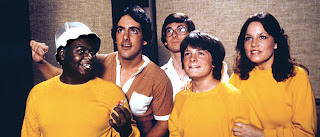
Midnight Madness
What should I group this comedy with ... College humor? That's pretty accurate. It appeals to the same compartmentalizing that attracts me to classic anime as well as the obstacle course/puzzle solving pacing that I'm naturally drawn to. The set up is that a weirdo genius kind of guy - not really sure what his purpose is on the campus is... prof? student? no idea, and no one likes him - anyway he sets up a game called The Great All Nighter, an all night scavenger hunt following the clues that he's arranged around the town at various locations ending at a final destination. I can't remember what the prize was.. probably money. But mostly bragging rights because he pits groups of college stereotypes against each other. The nice, fair-play kids. The lazy, bullying, cheating types. The meat-headed jocks. The ambitious sorority women. And the nerds. Grouped by color! ๐Ÿ˜‚๐Ÿ˜‚... I'm a dork.. It's a fun movie that can employ adult humor without being as bawdy as, say, "Porky's" because of that game element which makes for some damn clever riddling along the way. There's also a heart element with the screen debut of Michael J. Fox as the kid brother of the main good guy character (who was also the Dr Pepper kid in those old commercials that nobody seems to remember but me.) And seeing how the game master keeps track of everyone is also a fascinating tech point for 1980. Naturally the fair-play kids win, but everyone is accepted at the party at the end except the bullies who get their comeuppance. It's a feel good obscure flick.


Day 5
Runaway
This one is buried so deep I had to look it up because it's been a long time since I've seen it. All I remembered clearly was the robotic spiders. But I discovered why I liked this movie so much as a kid - it's the work of Michael Crichton. I wasn't as aware of him in 1984 but since I've discovered him, I'm not at all surprised that I was drawn to his fantastical style of science fiction. It's a future where robots are a common household tool. If they get loose they become pests and a division of the police is dedicated to dispatching them. They're not taken seriously until a robot commits murder. But it's not about machines coming to life. It's about the bad guy played by Gene Simmons from KISS (which, I confess, is why I first watched) weaponizing the robots which is kind of an obvious consequence in this scenario. But his ambitions aren't just local. He wants to get defence contracts and such. Perhaps the plot was overly complex and it clashed with the aforementioned spider type robots which, admittedly cheesy, would be more suited to suspense/thriller plots rather than governmental arms systems. But State of Fear was the same way so it has my willing suspension of belief. Like I said, it's been years since I've seen it, so there are gaps. Unfortunately, as good as I remember it being and starring the likes of Tom Selleck and Kirstie Alley, it came out in a golden year of box office smashes and ended up being smashed into obscurity itself and it's kind of a shame because it really was a cool little movie.


Day 6
The Last Unicorn
Second and final animated entry. Second of the triad of animated movies that I watched with rapt attention growing up. The third, The Secret of NIMH, is a little more well known. But from what I understand it was vastly different from the book it was taken from, which I haven't read yet. The Last Unicorn, on the other hand, was another extremely good adaptation of the book. It's like the less known it is, the harder the filmmakers try. At least back in the day. This is a fairy tale, but not a cutsie, musical Disney type (although there two short songs which were awful because they let the voice actors sing them.) Songs notwithstanding, it's more adult, along the lines of Grimm, though not overly dark. A lone unicorn sets out on a quest to free all the other unicorns from the sea prison of a mad king (my first introduction to the voice of Christopher Lee.) Along the way she's forced to become human to disguise herself and nearly loses her identity as she begins to fall in love with the prince. But in the end she is returned to her true form and saves her kindred. It's definitely a movie for girls with the two female characters being the strongest presence, driving the narrative. I liked the songs that the band America recorded for the theme and background "traveling" music. It enhanced the beautiful sadness that coupled with a happy, but bittersweet ending. I know there are at least a couple of people in my friends list that know this movie, but that doesn't make it well known. It just means I have some kindred spirits with this one.


Day 7
The Cat From Outer Space
First of two family movies. This is a a Disney movie. They cranked out a ton of high budget blockbusters that have enjoyed world wide acclaim. They also turned out a ton of cheaper productions that were put out in the meantime. Kind of like the B sides of records. The Misadventures of Merlin Jones, The Ugly Dachshund, That Darn Cat, etc. Probably enough to fill their own list. But my pick is this wonderful movie I haven't seen in light years. The Cat From Outer Space is about a spaceship making an emergency landing and being taken by the government. Since the alien is a cat, he's not noticed. He finds an employee to help him fix his ship, able to talk to him with a special glowing collar. They need gold to fix the ship. Since the collar makes him telekinetic too, they try manipulating different gambling ventures to raise the money to get the gold. Jake ends up staying and getting American citizenship. And I named my first cat after him. ๐Ÿ’– There's lots of conflict and dicey situations and Jake is as helpless as a regular cat without his collar. I wish I could remember more, but it's been a long, long time. And the quality was really great for being on the low end of the scale and not getting much reach. I really need to find this movie and watch it again. It was always one of my very favorite children's movies.


 Day 8
The Adventures of the Wilderness Family (trilogy)

To quote an online reviwer: "A couple of hippies living in Los Angeles who were forced to grow up and get jobs when they had kids, decide they've had enough of the smoggy city and pack up their family to move to the Rocky Mountains." He was poking fun at it a little because there were a lot of" back to nature" kids films in that era. (1975) But this movie was one of the the very best. They went completely off the grid, as we would now say it, and the movie explores their challenges like building their home from scratch, homeschooling the kids, and teaching survival. But it also adds an element of danger with the large grizzly bear the wife and kids are left to defend their new home against while the daughter is gravely ill and the dad is off getting medicine. Lots of melodrama and some corn, but also so much real heart, good acting, and a memorable soundtrack. I put trilogy in parenthesis because there were two others but they almost aren't necessary. The second is basically the same as the first only it's winter, they're facing wolves, and the mom is sick. In the third one the government is the enemy, trying to get them off the land. I can't remember much about that one because the plot was too heavy for me as a child. Though I'd like to see it again and judge it with adult eyes. But I always loved them, especially the first one and there are a lot worse movies to impress upon young children. 


Day 9
Blind Fury
I saved the best two for last. A pair of Rutger Hauer movies. I was on a Rutger Hauer bender trying to find everything he ever made and much of it is obscure. This is one of the best, in my opinion. A Vietnam vet, Nick, who was blinded in the war goes to visit an old friend, Frank, who happens to be in trouble, blackmailed into cooking designer drugs for a high level crime boss. It was Frank who had abandoned Nick in the battle that left him blind. However he's is not a helpless disabled person. He mastered the samurai sword from villagers that rescued him and he's not returning for revenge but closure. After Frank's ex-wife is killed Nick promises to take his son to him and so the adventure begins. An American take on a samurai swordsman story as he rescues his friend, kills the bad people he's fallen in with, and reuniting father and son. His friend even gets to redeem himself for his cowardice back in the war. Instead of a mystical ancient Japanese setting, it modern day Reno, Nevada. None of this is legally plausible, of course, but that was the beauty of the 80's. Real life scenarios were optional. It's a fun adventure film and Hauer plays the character Nick as gentle, calm, and charming. A really low-key kind of badassery that makes it unique. It's just good popcorn fun in the same vein as They Live, only it never acquired the same cult status. Probably because it wasn't a typical story with a clearly defined motive like revenge or saving the world. But I enjoy things that are different and if you do too, you should give this one a watch.


Day 10
Ladyhawke
I'm not sure how obscure this one is. It has some big names, but it didn't recover its budget at the box office. If not obscure, it's certainly forgotten. And I don't see how.... This is a fine piece of fantasy. It's a fairy tale of sorts, as well. An evil bishop desires the lady Isabeau but her heart belongs to his captain of the guard, Etienne Navarre, so he curses them. She can only exist in the day time as a hawk and he can only exist at night as a wolf, so even though they're always together, they're eternally apart. Ah, my heart! I'm an abject sucker for unrequited love stories! Plot twist: killing the bishop won't break the curse, which complicates things. But with the help of an escape thief they work out the riddle of how to break the curse during a solar eclipse and it comes down to the nail biting final moments. This is a great movie. Rutger Hauer, again, as Navarre and Michelle Pfeifer as Isabeau are so believably, beautifully tragic that the audience's hearts can't help but break for them. It's almost a shame that Hauer's best known work is as the heavy from Blade Runner. I kind of wasn't happy with Matthew Broderick as the thief, but it wasn't enough ruin the vibe of the movie. I know I have some overlap with my list partner on this one. Has anyone else seen this hidden gem of a movie?