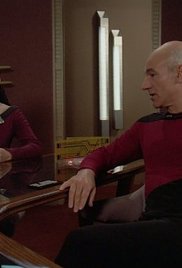
This is a pretty good second season episode. I've always liked it. It isn't the most perfect use of a time anomaly, but it's not bad. And Patrick Stewart was improving Picard more and more with each episode. You can tell at this point that it wouldn't be long before the show would really break out and start excelling in almost every episode.
The teaser scenes at the beginning were getting better. Sometimes they would telegraph the plot of the episode or sometimes not. In this case, there was a little forward thinking going on when Riker mentions his father. I don't know if they'd planned to make the episode with his father at this point... most likely they did because it's the next one - it was probably even filmed first - but it was an example of how these throw away scenes could be used for later episode fodder, especially in the area of character development. It's a funny scene and a nice lighthearted start to the otherwise exciting and eerie episode.
They come across a drifting shuttle craft that turns out to be one of their own shuttle crafts with Picard inside. This makes for some good mind-bending which makes the episode appealing. It's a genuinely good reason for the crew to be freaked out and for Picard to be incensed. It's still on the simple side. The shuttle craft is from six hours in the future and a lot of time is spent wondering and worrying about it. Then you find out that the Enterprise was destroyed and Picard was the lone survivor in this shuttle craft. And again, we spend a lot of time pondering and speculating. I'm not complaining too much this time. I'm just pointing out that the full potential of an episode hadn't been reached yet. As the series goes on, they'll manage to pack more and more detail into episodes even when the plot is simple. This concept of time distortion and a coming disaster is tweaked and improved upon later on with more detail and intensity than just that of the characters looking freaked out and worried with a lot of dramatic pauses. But this is a very good first try.
This is one of the first really great Picard episodes. The Measure of a Man was the best of Picard so far, but you only got a small dose of that in the trial scene. But this episode is obviously focused on him from beginning to end. Up till now, for the most part, whenever Picard was offended or irritated, it seemed overdone considering the situations. I felt like he was wound up too tight and a little on the snobby side. But in this episode, his discomfort and anger are justified. He's a proper captain that wouldn't abandon his crew to a disaster so that he might survive and you see how the thought of that embarrasses him and strengthens his determination to find out what really happened. Although, the audience knows he would never save himself first and you have to wonder why you see doubt in the rest of the crews' eyes as they spend all that time worrying and speculating. That never seemed right.
Patrick Stewart gets to stretch his acting legs a little. His confused and disoriented future Picard is truly shocking. It's the first time you see Picard really lose control (I absolutely do not count The Naked Now; it was an abomination) and it's almost heartbreaking to see his present self have to look at it. I was a little uncomfortable with the way he badgered his helpless doppelganger for information, but I think that was by design as well... this effect on the viewer supported the drama displayed by Pulaski and Troi. It made it appropriately terrifying. Nicely done, over all. As the episode progresses, it turns out that as time goes forward towards the catalyst event, the future Picard becomes more and more aware of his surroundings and is able to function.
The space effects were so beautiful. I guess it must have been easier than setting up nice looking planet scapes in the first two seasons. And I'm glad they went to the trouble of the CGI animation for the strange phenomenon that touches off the sequence of events that leads the future Picard back into the past. It gives the episode a good flow
Then all of a sudden towards the end of the episode it all starts to go together. The disturbance in space starts sucking the Enterprise inescapably inward and firing energy bursts at Picard specifically... for no reason. That's one of those first two season type of cop outs that are so very annoying to me. However, it's forgivable to a certain degree because Stewart makes the rest of the story so entertaining. This is obviously why the other Picard decided to abandon ship so as to save the crew. He decides to allow his future self to start playing out the sequence of events as they'd already happened since, although he could function now, he apparently wasn't aware of the fact that he was in the past. The purpose was to find out if there was ever another option on his mind. And it turns out there was.
His other idea would've been to go through the disturbance instead of trying to escape it. So he kills his future self and decides to go with this other option which works. Then the future shuttle and Picard disappear. Like I said, it's not perfect. This Star Trek series was usually more careful when dealing with time travel, because it's so easy to blow holes in it. In this case everyone remembers what happened even though that would probably not be the case if it'd really happened. But, no matter. It's one of the better episodes in season two.
I'm torn on how to score it. I like it enough to award four stars, but the typical irritants that litter the first and second seasons (time wasting, things happening for no real reason, wrapping up without much preamble in the last 10 minutes or so) are a little more prominent than I'd like them in what could've been a really great episode. I'll go three and a half on this one, but with a note that this one could've easily been four starts as well.
Okay, so two days til the next Star Wars movie. I will not be attending. I will not be purchasing either for PPV or for DVD. Nor will I even be renting or Netflixing. For as much as I've written on the subject, I don't think there are quite enough words to describe the let-down that The Force Awakens was and it's hard to get past it.
Does this mean I'm prejudging it to be awful? No. This one actually seems promising by comparison. It's not the signature rehash method of Abrams. I understand Lucas was consulted on it and he actually approves of this one. The trailers are interesting and not as vague as TFA. It looks like it's slowed down enough to attempt some real story and focus on more than one character. And I didn't fail to notice the tie-in of Mon Mothma which seems like a good move.
But my trust is not easily won. My attitude at this point remains to be: Fool me once, shame on you; fool me twice shame on me. I can also see in the trailers the popular style of movie making as of late which tends towards the vapid and oversimplified, and I'm leery. I suppose there wouldn't bee too much wrong with that since it takes place between trilogies and can stand alone. But I still don't see that as a good excuse to sacrifice depth for action. No. Even if this one turns out to be alright, I think I'll just be stepping back from the whole thing now as I did with the Star Trek reboot stuff. They're both proof that it's nearly impossible to strike gold twice in the same spot. I don't like all movies just for the sake of them being movies or a certain genre or a certain specific story. My standards are different. I'm perfectly willing to give Rogue One a chance though... when it rolls around to a movie channel.
So many great lessons in
leadership and rudimentary layouts of different types of government from a
definite class system to a republic to a totalitarian society.As a kid it one of the movies that I watched
over and over ad nauseam and I never outgrew it and I've finally read the
book.I'm very impressed with how the
movie did a great job in staying as true to the book as possible (in 1978, no
less)... true to the point where large parts of it I never fully understood
until reading this book.I have a copy
with a forward by the author which explains that it was just a story for his
kids on a long drive, but either they were very grown up for their ages, or he
altered it slightly when putting it in novel form.It's never seemed like a "kid's"
story and it is rich and textured with military type heroes, accurate psychological
profiles and even of faith in the rabbits' primitive mythology.I loved it and now the movie is on a very
short list of mine of approved book adaptations.
And I can't see the end without balling my eyes out anymore. It's just relevant on so many levels and means different things to people at different ages. I was pretty young when I first saw it.
Everyone complains about how violent it is, but all it is is realistic. Even though they are anthropomorphized rabbits, they can't physically do anything a real rabbit can't do like write letters or sword fight. In the book it's even a minor zoology lesson in rabbit behavior along side the story. I'm glad I grew up in a time when they made more serious cartoons that dealt with adult themes and wisdoms. I love the book and the movie. Definitely a childhood favorite.
That clip is from the middle of the movie. Another scene that makes me cry like crazy as an adult, even though it's a good thing.
If anyone hasn't scene this movie or read this book they really should. It's one of the best ever.
One of the cheesier episodes to come out in the first two seasons. But cheesy in a likeable kind of way. This episode resembles an episode of Twilight Zone more than Star Trek. But I've always had kind of a soft spot for it. Maybe I'll remember why as I'm writing about it.
It's got a good, mysterious beginning. The Klingons aren't behaving like animals for a change. Instead they're being normal allies; they report some debris floating around a nearby planet. It turns out to be an old NASA vessel of some kind. They find out that the planet is completely uninhabitable except for one tiny spot that can support life, so naturally they have to investigate further. Predictable, yes. And the revolving door in the middle of nowhere is another cop out for an appropriately creative set design. These elements are the bad sort of cheesy.
But, the away team is there to investigate so they go right on in and find themselves trapped in a bad novel. I guess that's one reason that even, though it's clearly an inferior episode, it still has a lot of appeal especially to avid readers like myself.
Of course they don't know that at first. They just find themselves in a mid-twentieth century American casino and unable to transport once they're inside or pass back through the revolving door, although they can still communicate with the Enterprise. Weak science fiction. Again, they were counting on the drama within to distract from the fact that it's not a solid plot. Or in this case the comedy for the most part. They decide to split up and get to know the patrons while watching the seedy details of a bell hop's love affair with a gangster's girlfriend unfold before them. Worf's confusion is genuine... not just because he's being portrayed as a stupid Klingon because Riker is equally baffled by the twentieth century layout. And Data's part is the funniest. He takes up with a sleazy gambler who is trying to take advantage of the lady he's "helping." I think it's more digestible than other episodes with weak base storylines because it behaves like a holodeck episode. Nobody notices Worf is an alien or sees Data's skin and eye colors or anyone's uniform. The people they meet are completely unhelpful because they have no place else to be in their little world than right there in the casino. It's actually perfect for a holodeck scenario, it's just that they chose to make it a planetary adventure and that's why it loses credibility.
So, they explore the rooms upstairs and discover that the astronaut that had died there had been kept there by the aliens that accidentally caused his ship to crash. Feeling guilty and having nothing else to go on, they thought that life on Earth was genuinely represented in a pulp novel that the astronauts had aboard and decided to set up a living version of it for the remaining astronaut to survive in as compensation for his loss of ship and crew. From his diary they learn all of this and also that he couldn't leave through the revolving door either. But, really, where would he have gone? (That's my question, not theirs.) I guess I'd want to leave too if I had to live a bad novel over and over again for years until I died of old age. But for the Enterprise people, you can see their sense of urgency in wanting to find a way out now.
So they tell the Captain about the book and he gets right on it. He calls it up and looks it over with Troi. I would like to point out that although the phrase, "It was a dark and stormy night" is often used as a spoof of the beginning of bad novels and stories over the years, this episode included, that it's also the opening sentence of A Wrinkle In Time which is still a classic and award winning young adult book. So, it's not always an unpromising start to a story.
They allow the novel to play out as it was written without interfering. I assume that's what the astronaut had tried several times himself, but it still seems like the logical course of action. I did do a little research and there is in fact no real novel called The Hotel Royale which is the title of the book in this episode. I think what they have lined out for its story in this episode is an altered version of Casino Royale without the James Bond element and with a sufficiently corny plot that a person would become depressed about having to live through it repeatedly.
At some point they had to get back to the shaky plot of this story and figure out a way to get the away team out of there. They discover that the casino is bought out by foreign investors at the end of the novel so they gamble until they break the bank and simply buy the casino from the manager thereby taking the parts of the foreign investors for themselves. For whatever reason, this allows them to go out of the mysterious revolving door and into the empty space where they can transport back to the ship. It's so painfully thin and makes no real sense at all. And it's obviously something the astronaut could never have done on his own. They could never have done it either if not for Data.
Data really is the saving point of the show. I would call this a Data episode even. His interaction with the southern gambler, and his adoption of human mannerisms when he fixes the dice and gambles them into the fortune they need is really priceless and always great to watch. It isn't overdone and an excellent example of Data learning and imitating behavior like he so often does in the series. Most of the time during the first two seasons it was awkward, but in this episode it's very smoothly executed by the writers and Spiner. The thing I've noticed about this episode is that people either hate it - understandably because like I said, it's inferior - or they can't help but like it. I fall into the latter category and the clip above of Data saving the day is one of the reasons. The comedy isn't overdone and there's some genuine heart in it. And on the whole I'd call it a "for fun" episode that could never have been meant to be taken too seriously anyway.
It probably only deserves two and a half stars for content but I'm giving it three because I do have a soft spot for it. There were a lot of worse episodes than this anyway. It's good harmless fun.
Hang in there, it'll get better soon. This is another weak episode. Over all, I found it a little on the boring side. There seems to be a couple different things going on in it and, of course, some TOS recycling as well.
The idea itself isn't new. A standoff with the Romulans over technology. This had been going on since the first series. I still sit in amazement of how TNG ever made it past these first two seasons when it seemed like they had absolutely nothing new to offer in the way of ideas, characters, and stories. The most disappointing things are the vagaries. There's technology at stake here, but it doesn't really say what. Only that it's advanced and by the end of the show nobody can get it anyway.
I mean, it was a watchable episode, don't get me wrong. But it was a little disjointed and frustrating. I just didn't like being teased with this artifact that Captain Varley talks about only to find out that it has nothing to do with what goes on in the story other than that it's a map to get him to the Nuetral Zone where this fabled planet Iconia existed once. I was just tired of the premise of these once powerful but now lost worlds at this point. And the fact that Varley is blaming the design of the starships for his system failures is kind of silly. It's like he's not smart enough to figure out that whatever probed them from the planet is the most likely cause of their troubles. Then the Romulans show up as one would expect and we have to waste a lot more time than necessary to realize that, no, they didn't blow up the Yamato. And they fall back on the simplest form of story telling. Both ships will contract the "contagion" now and they only have a short period of time to figure it all out before everyone dies. Nothing new.
However, the cool part is that it's a computer virus instead of just another disease. A lot of strange things start happening on the ship because it was transferred with Varley's personal log. Poor Geordi.. lol! This was a pretty novel concept at the time. It's not even 1990 yet. Most people didn't have a PC or two around their houses and Picard's little laptop type view-screen in his ready room was just sci-fi magic to the average person at the time. It made it an interesting plot twist.
I don't really know how the Romulan ship got infected. It's been a long time since I've seen this episode, but I don't think they explain it very well if at all. I'm sure they were just counting on the fact that a person was more likely to remember Picard's first order of tea, earl grey, hot coming out as a potted plant than details like that. And although it's memorable and funny, it's just one of the many time wasting portions of the episode before they start to try and solve the problem.
Picard decides to go down to the surface to stop the probes which, of course, is the only logical thing to do even though it won't stop the computer problems cascading on the ships. I have to admit I liked the gateway idea even though it was a total rip off of All Our Yesterdays. It really is such a nice idea, I was glad to see it attempted again with better graphics. The difference between the two is that in Yesterdays the gateways go into different time periods of the planet's past. In this episode the Gateway is used to simply travel distances great and small in the universe. Once they're on the surface they don't dare take the shields down to beam them back since the Romulan captain is still on the attack, but they then see the Enterprise and the Romulan ship cycling through the gateway on the planet, so there will be a way out.
The captain has Worf take Data back after he gets zapped by the control panel in attempt to figure out how it works. The captain stays behind to destroy the probing system and Data would seem to die from his injury back on the Enterprise. This part is funny now looking back on it - he needed a hard reboot to purge the virus. Ever since we moved into the cyber age we make jokes about turning it off and then turning it on again. They conclude that the ships' computers need the same sort of thing to make it all better. All this episode for that simple solution. But, I must remember again that it wasn't a common occurrence in 1989.
So, the artifact isn't connected to the action and the probes and gateway aren't really connected to the solution. It made it kind of consistently anticlimactic throughout the whole show. Data's behavior when he comes back to life is a little overdone on the comical front. Picard doesn't have time wait for the Enterprise to come around in the gateway after he starts the destruction sequence and has to settle for the Romulan ship instead. That part is fun. The presence of Picard always manages to save parts of the show somehow. They beam him over and give the Romulans instructions on how to purge their ship even though they're self destruct has (I assume) started itself randomly. I don't know how they're suppose to shut down their systems to "reboot" if they can't stop their auto-destruct, but it all happens very quickly and then the ships go their separate ways like nothing happened after all that posturing and chest beating and destroying of supposedly valuable technology. Like I said, hang in there.
It isn't the worst episode, but it isn't an overly memorable episode either. It was a touch on the ADHD side with too many small holes that were just irritating. Two and a half stars.
Just really tired today so I'm posting videos that compare star ship sizes
This first one is mostly Star Trek ships. It's hard to see the writing and I think that it's not as accurate. DS9 should be bigger because the smaller ships dock at it.
Next is Star Wars comparisons by the same people.
This last one is the best. It includes a large variety of Sci-Fi series other than Star Wars and Star Trek.