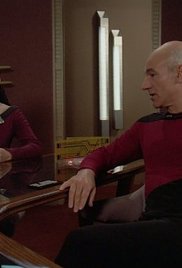
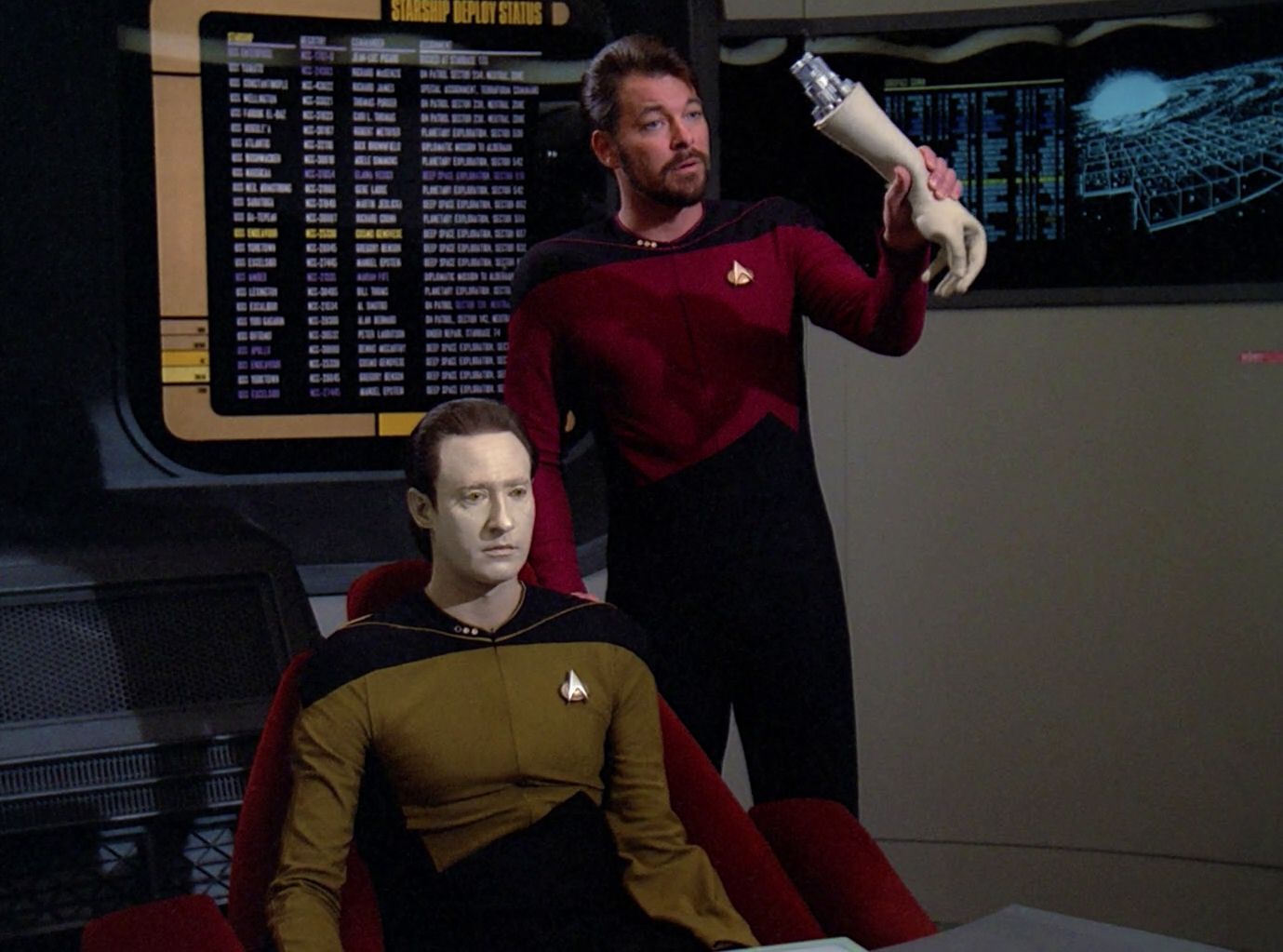
One of the cheesier episodes to come out in the first two seasons. But cheesy in a likeable kind of way. This episode resembles an episode of Twilight Zone more than Star Trek. But I've always had kind of a soft spot for it. Maybe I'll remember why as I'm writing about it.
It's got a good, mysterious beginning. The Klingons aren't behaving like animals for a change. Instead they're being normal allies; they report some debris floating around a nearby planet. It turns out to be an old NASA vessel of some kind. They find out that the planet is completely uninhabitable except for one tiny spot that can support life, so naturally they have to investigate further. Predictable, yes. And the revolving door in the middle of nowhere is another cop out for an appropriately creative set design. These elements are the bad sort of cheesy.
But, the away team is there to investigate so they go right on in and find themselves trapped in a bad novel. I guess that's one reason that even, though it's clearly an inferior episode, it still has a lot of appeal especially to avid readers like myself.
Of course they don't know that at first. They just find themselves in a mid-twentieth century American casino and unable to transport once they're inside or pass back through the revolving door, although they can still communicate with the Enterprise. Weak science fiction. Again, they were counting on the drama within to distract from the fact that it's not a solid plot. Or in this case the comedy for the most part. They decide to split up and get to know the patrons while watching the seedy details of a bell hop's love affair with a gangster's girlfriend unfold before them. Worf's confusion is genuine... not just because he's being portrayed as a stupid Klingon because Riker is equally baffled by the twentieth century layout. And Data's part is the funniest. He takes up with a sleazy gambler who is trying to take advantage of the lady he's "helping." I think it's more digestible than other episodes with weak base storylines because it behaves like a holodeck episode. Nobody notices Worf is an alien or sees Data's skin and eye colors or anyone's uniform. The people they meet are completely unhelpful because they have no place else to be in their little world than right there in the casino. It's actually perfect for a holodeck scenario, it's just that they chose to make it a planetary adventure and that's why it loses credibility.
So, they explore the rooms upstairs and discover that the astronaut that had died there had been kept there by the aliens that accidentally caused his ship to crash. Feeling guilty and having nothing else to go on, they thought that life on Earth was genuinely represented in a pulp novel that the astronauts had aboard and decided to set up a living version of it for the remaining astronaut to survive in as compensation for his loss of ship and crew. From his diary they learn all of this and also that he couldn't leave through the revolving door either. But, really, where would he have gone? (That's my question, not theirs.) I guess I'd want to leave too if I had to live a bad novel over and over again for years until I died of old age. But for the Enterprise people, you can see their sense of urgency in wanting to find a way out now.
So they tell the Captain about the book and he gets right on it. He calls it up and looks it over with Troi. I would like to point out that although the phrase, "It was a dark and stormy night" is often used as a spoof of the beginning of bad novels and stories over the years, this episode included, that it's also the opening sentence of A Wrinkle In Time which is still a classic and award winning young adult book. So, it's not always an unpromising start to a story.
They allow the novel to play out as it was written without interfering. I assume that's what the astronaut had tried several times himself, but it still seems like the logical course of action. I did do a little research and there is in fact no real novel called The Hotel Royale which is the title of the book in this episode. I think what they have lined out for its story in this episode is an altered version of Casino Royale without the James Bond element and with a sufficiently corny plot that a person would become depressed about having to live through it repeatedly.
At some point they had to get back to the shaky plot of this story and figure out a way to get the away team out of there. They discover that the casino is bought out by foreign investors at the end of the novel so they gamble until they break the bank and simply buy the casino from the manager thereby taking the parts of the foreign investors for themselves. For whatever reason, this allows them to go out of the mysterious revolving door and into the empty space where they can transport back to the ship. It's so painfully thin and makes no real sense at all. And it's obviously something the astronaut could never have done on his own. They could never have done it either if not for Data.
Data really is the saving point of the show. I would call this a Data episode even. His interaction with the southern gambler, and his adoption of human mannerisms when he fixes the dice and gambles them into the fortune they need is really priceless and always great to watch. It isn't overdone and an excellent example of Data learning and imitating behavior like he so often does in the series. Most of the time during the first two seasons it was awkward, but in this episode it's very smoothly executed by the writers and Spiner. The thing I've noticed about this episode is that people either hate it - understandably because like I said, it's inferior - or they can't help but like it. I fall into the latter category and the clip above of Data saving the day is one of the reasons. The comedy isn't overdone and there's some genuine heart in it. And on the whole I'd call it a "for fun" episode that could never have been meant to be taken too seriously anyway.
It probably only deserves two and a half stars for content but I'm giving it three because I do have a soft spot for it. There were a lot of worse episodes than this anyway. It's good harmless fun.
Hang in there, it'll get better soon. This is another weak episode. Over all, I found it a little on the boring side. There seems to be a couple different things going on in it and, of course, some TOS recycling as well.
The idea itself isn't new. A standoff with the Romulans over technology. This had been going on since the first series. I still sit in amazement of how TNG ever made it past these first two seasons when it seemed like they had absolutely nothing new to offer in the way of ideas, characters, and stories. The most disappointing things are the vagaries. There's technology at stake here, but it doesn't really say what. Only that it's advanced and by the end of the show nobody can get it anyway.
I mean, it was a watchable episode, don't get me wrong. But it was a little disjointed and frustrating. I just didn't like being teased with this artifact that Captain Varley talks about only to find out that it has nothing to do with what goes on in the story other than that it's a map to get him to the Nuetral Zone where this fabled planet Iconia existed once. I was just tired of the premise of these once powerful but now lost worlds at this point. And the fact that Varley is blaming the design of the starships for his system failures is kind of silly. It's like he's not smart enough to figure out that whatever probed them from the planet is the most likely cause of their troubles. Then the Romulans show up as one would expect and we have to waste a lot more time than necessary to realize that, no, they didn't blow up the Yamato. And they fall back on the simplest form of story telling. Both ships will contract the "contagion" now and they only have a short period of time to figure it all out before everyone dies. Nothing new.
However, the cool part is that it's a computer virus instead of just another disease. A lot of strange things start happening on the ship because it was transferred with Varley's personal log. Poor Geordi.. lol! This was a pretty novel concept at the time. It's not even 1990 yet. Most people didn't have a PC or two around their houses and Picard's little laptop type view-screen in his ready room was just sci-fi magic to the average person at the time. It made it an interesting plot twist.
I don't really know how the Romulan ship got infected. It's been a long time since I've seen this episode, but I don't think they explain it very well if at all. I'm sure they were just counting on the fact that a person was more likely to remember Picard's first order of tea, earl grey, hot coming out as a potted plant than details like that. And although it's memorable and funny, it's just one of the many time wasting portions of the episode before they start to try and solve the problem.
Picard decides to go down to the surface to stop the probes which, of course, is the only logical thing to do even though it won't stop the computer problems cascading on the ships. I have to admit I liked the gateway idea even though it was a total rip off of All Our Yesterdays. It really is such a nice idea, I was glad to see it attempted again with better graphics. The difference between the two is that in Yesterdays the gateways go into different time periods of the planet's past. In this episode the Gateway is used to simply travel distances great and small in the universe. Once they're on the surface they don't dare take the shields down to beam them back since the Romulan captain is still on the attack, but they then see the Enterprise and the Romulan ship cycling through the gateway on the planet, so there will be a way out.
The captain has Worf take Data back after he gets zapped by the control panel in attempt to figure out how it works. The captain stays behind to destroy the probing system and Data would seem to die from his injury back on the Enterprise. This part is funny now looking back on it - he needed a hard reboot to purge the virus. Ever since we moved into the cyber age we make jokes about turning it off and then turning it on again. They conclude that the ships' computers need the same sort of thing to make it all better. All this episode for that simple solution. But, I must remember again that it wasn't a common occurrence in 1989.
So, the artifact isn't connected to the action and the probes and gateway aren't really connected to the solution. It made it kind of consistently anticlimactic throughout the whole show. Data's behavior when he comes back to life is a little overdone on the comical front. Picard doesn't have time wait for the Enterprise to come around in the gateway after he starts the destruction sequence and has to settle for the Romulan ship instead. That part is fun. The presence of Picard always manages to save parts of the show somehow. They beam him over and give the Romulans instructions on how to purge their ship even though they're self destruct has (I assume) started itself randomly. I don't know how they're suppose to shut down their systems to "reboot" if they can't stop their auto-destruct, but it all happens very quickly and then the ships go their separate ways like nothing happened after all that posturing and chest beating and destroying of supposedly valuable technology. Like I said, hang in there.
It isn't the worst episode, but it isn't an overly memorable episode either. It was a touch on the ADHD side with too many small holes that were just irritating. Two and a half stars.
Just really tired today so I'm posting videos that compare star ship sizes
This first one is mostly Star Trek ships. It's hard to see the writing and I think that it's not as accurate. DS9 should be bigger because the smaller ships dock at it.
Next is Star Wars comparisons by the same people.
This last one is the best. It includes a large variety of Sci-Fi series other than Star Wars and Star Trek.
A while back I was home sick from work and I was thinking back to a couple of cartoon movies that I watched repeatedly in my early childhood. It occurred to me that you can find anything on the internet nowadays, so that's exactly what I did... big mistake! Fleeting segments of these movies had stayed burned into my brain for years although I couldn't really remember what they were about until I spent the whole morning watching them in their entirety on the the computer. Seeing them some 30 years later, I sat amazed wondering what I could've ever liked about them. It's just funny because much of the time when we look up childhood memories we remember what it was that attracted us to them. I do remember what I liked, but e-freakin'-gad, they really were awful and I can't remember how they held my attention for over an hour. It must have been a blessing and a curse for my mother. And I wonder how they've effected me on a subconscious level all these years.
Dot and the Kangaroo, 1977. It's about a girl that gets lost in the Australian outback and a Kangaroo finds her and helps her find her way home. Sounds sweet enough, but this movie was so unnecessarily sad and just an over all downer. The Kangaroo had lost her own joey and speaks of it often as her reason for wanting to find the child's parents. It even indicates in certain parts that she may yet find her own joey. She finds Dot's home at the end, which seems like a happy ending too, right? Well, when she leaves Dot at her farm, Dot is heartbroken and cries out for her to come back while the kangaroo hops away crying because she'll miss Dot like she continues to miss her own joey who it looks like she will never find.
I can't find too many clips on YouTube. Some of the songs and an upload of the entire one hour and eleven minutes of the movie which I wouldn't share here because it's really not worth the time to watch. I remember liking it because it used live action and animation at the beginning and end. When the kangaroo hops away it melds from and animation to a real kangaroo running across a field. Also one song still stays in my mind - The Pouch of a Red Kangaroo, which actually is pretty catchy. I was thoroughly depressed after watching it again as an adult, however. I sometimes wonder if this movie is partially responsible for me having such a pessimistic view on life.
Next I watched The Water Babies (1978), which I only found in segments, but I got them all. And honestly I couldn't watch all of them. Holy cow this has got to be the most annoying movie ever made. I think I vaguely remember my mother being exasperated every time I wanted to see it. Now I know why. It's a mix of live action and animation as well. It's a full length movie and the live parts are longer. And they're boring. I didn't remember them being that awful. Bad actors, and the story was absolutely nonsensical. The boy works for some corrupt chimney sweeps who steal from the houses they "clean" and meets a little rich girl in a house while the men steal from the house. They get caught and they blame him and he has to run from them and falls into a river where it turns to animation. He has to help some "water babies" escape from some shady ocean characters before he can get back to the surface. In the end he becomes the hero because he got the burglars caught and gets to show his little rich girlfriend that his story about the water babies is true. One part has nothing to do with the other. And you can't understand a lot of the characters who do a lot of shouting and singing unmemorable songs. It's enough to make anyone crazy.
The reason I remember it so well is because of the one song High Cockalorum. It's just as idiotic as everything else, but the tune is catchy for small children and I never forgot it. Like I said, I ended up just fast forwarding through a lot of segments as I watched that morning. I would rather be depressed by Dot and the Kangaroo than listen to the utter insanity of this one. However, this one may have planted the seeds of my love of British stuff. That's a rough planting though. Lol.
Humbert Allen Astredo... it's a mouthful of a name. I'll just go with his Dark Shadows name - Nicholas Blair. He's one of the best characters ever made on the show and Astredo was one of the best actors on the show.
He was brought in to be a kind of control for Angelique. He was her keeper for a while after the 1700's story that explained Barnabas' damage. He was smooth and had an amazing voice.
Nobody could preform an occult ritual quite like Blair. He would start quietly and rise to a fitted passion in a most believable and breathtaking fashion. He had a lot of lines to memorize to preform these dastardly rituals and he almost never missed a word. Or, if he did you couldn't tell because he was a fantastic method actor. Of course, after a while, a person could probably ad-lib some of the enchantments based on previous scenes. But Astredo made it special because he would always start by striking a pose of one who is controlling the elements, as in the top picture.
He also looked really sharp all the time. Even in his sixties fashions you could pluck him up and put him in the modern world and he wouldn't look much out of place. Debonair and dashing. A man with a purpose. Always in complete control of every situation. His character never got to expand beyond that of a villain. He was slightly altered in different timelines. He was an all-powerful warlock in one and more of a wannabe warlock in another who ultimately had to be a subordinate to the primary villain of the story line, but he was always shady not to be trusted.
Of course, he had a thing for Maggie Evans like most of the characters and fans, which was his downfall at one point. But he would always resurface more charming and evil than ever.
Here's a clip of Nicholas Blair sparring with Reverend Trask played by Jerry Lacy, another one of the best actors on the show. Classic gold.
I'd once described the second season as bipolar, but it can also be described best as Star Trek trying to break out of its shell. Sometimes it would peck and push and really make some progress as you could see in the strength of the last episode. And then it would flounder and roll around in a kind of rest period as you can see in another series of so-so episodes beginning with this one.
You may be expecting some snide comments or whining on my part because it's a Wesley episode. Well, the Wesley parts weren't all that bad in this one. I will say that if he'd been written in the way that I'd envisioned him as being written at this point, the two characters would've had a lot more in common - teenagers set apart for great and unknown destinies. It could've been a better match and they could've made a truly believable bond. But, even if they had been writing Wesley according to my vision, you'd still have to deal with the whole first love thing at some point which is done in every show where a teenager is involved. The premise isn't a bad one, it was just (as I must have said a million times by now) badly done.
The Enterprise is transporting two aliens that appear to be a teenage girl and her extremely overprotective guardian back to their home world where there are two warring factions that live on opposite sides of the planet; one on the daylight side, one on the dark side. She's going to become leader of the planet because she is apparently the product of a union between parents from each side. I mean... okay... so she's been raised away from the planet in a bubble, suffocated by a guardian that didn't properly socialize her with anyone and now the planet, I guess, wants her to be their leader because she'll magically make it work somehow due to her parentage and she'll never be able to leave the planet again for reasons that are unclear. That's so paper thin it could almost blow away. I guess it just loses me because you can tell they still didn't take these parts of the script seriously at the time. Instead of putting some backbone behind this story, they just let the base of the plot blow away with hopes that you'll be too distracted with the drama that is being pushed forward as the main part. Yes, the drama can be the main part. But when the conflict at the base of the drama is weak, the rest is somewhat lacking to a thinking person. Like a lot of other episodes, this concept is reworked again later on more successfully because they'd learned how to add real depth to the stories.
Added to everything you learn that Anya, the guardian, is a shape shifter which complicates the girl, Salia's, interest in meeting people and pursuing a relationship with Wesley. She can turn into a big hairy monster which is strangely (or not so strangely with the track record of the first two seasons) reminiscent of the salt vampire from The Man Trap. I thought the salt vampire was scarier too.
Unfortunately, it also adds confusion too. She can also apparently become a teenage girl to act as Salia's friend, and a furry little gremlin of some kind to be her pet. I didn't see the point in this scene. I guess it was to make you wonder where these other friends of hers came from since she was only beamed aboard with Anya, but it's kind of obvious what's going on and it just compounds problems with the parts that don't make a lot of sense. Salia's true form is none of these things; presumably Anya's isn't either. It just filler space that demonstrated how empty that base plot was.
But this episode isn't without it's nice moments that were actually good for Wesley's character. Another great use of the holodeck and beautiful scenery therein when Wesley takes Salia there to show her different places in the galaxy. It's a great scene. He's finding out that just being himself works fine to hold a girl's attention and she's dropping lamenting hints of how she'll never see all of these lovely places, which gives it all the emotional portrait that they were going for to distract from the fact that the spine of the story is so shaky. Or the emotional portrait that would've been better validated if the spine of the story made more sense at any rate.
He gets advice from Worf and Data as well, which are also comical and fun scenes to watch but his best lesson is learned in one of the best scenes in the show. A genuinely hilarious exchange between Riker and Guinan as Riker is attempting to show Wesley how to flirt and woo a woman. Not only is it funny, but it's not all preachy like other messages to teenagers where they're usually told directly just to be themselves. Wesley can see for himself as they're carrying on how ridiculous Riker's exaggerated pick-up style is and quickly realizes that he's on his own. The more subtle message that is sent to teenagers about love in that exchange is also nicely done in my opinion because it's done through comedy and the fact that after a while they're having more fun playing around with each other than actually advising Wesley on anything so that it doesn't leave Wesley or any teenager feeling as awkward as they would feel after asking any adult on this kind of subject.
Anyway, one thing leads to another and Wesley gets to see that his dream girl can shape shift into a monster too (no surprise to the audience) and it makes him reevaluate his feelings which I thought was kind of shallow on his part. But then I have to remember that his character is a teenager and the shock would probably have a more negative affect on him than an adult. And now as you can see, even I'm not talking about the base of the story line anymore, which, I suppose, means they accomplished what they intended in this episode. They get where they're going and the personal relationships are all resolved and we've all forgotten why everything escalated in the first place.
Wesley gets to see Salia in her true form which is a beautiful light being of some kind, although the effects weren't that great at the time. It makes him feel better about what she is. Worf, too, gains respect from Anya that he reciprocates which was just another time waster. I think they were trying to add to Worf's character in his trouble with Anya, but it was a little flat and unnecessary.
Another valid life lesson is learned at the end when Wesley is confiding in Guinan at the end of the episode. It's these parts that make it a watchable episode that is fairly intelligent for a change and is a perfectly acceptable addition to Wesley's character development. If only they'd tried this hard in all of his episodes.
Still, it's only a three star episode as the birth pains of the best Star Trek series of the bunch continues.
Great episode. It's called one of the top 10 must-see episodes and also the very first good episode of the series, and I'm apt to agree. When watching this episode there are moments when I forget that I'm watching something from the second season.
Okay, I'm going to get the most obvious plothole out of the way - In the first episode of the second season, Dr. Pulaski notes that Data's Starfleet service record states that he is alive. Because of that, the events of this entire episode should never have been an issue to begin with... he can't be determined to be property if he's alive. But I for one am glad that they forgot about that conversation. It was a topic that kept coming up indirectly like when they wrote Data as assuming that he was chosen for dangerous mission because he is an expendable machine. They'd even directly brought up the rights of an android before when Dr. Graves claimed he had more of a right to exist than Data because Data was a machine. Even though he obviously couldn't have made it this far in Starfleet if he weren't thought of as a sentient being, the matter still needed to be addressed on the show, as a kind of closure to all of the hinting around that the writer's did in regard to Data's nature from the very first episode when Riker expresses concern with the fact that he is a machine. It would've been harder to allow the character of Data to grow without this episode in place.
The first poker game! I often repeat the phrase, "they didn't know how popular this would become," but in this case it's the truest statement. Not only did it bond the characters and give us many humorous moments, it was also one of the most effective set-ups for many shows and if you put them all together, you can see just how the characters change and grow throughout the series. Another "first" that O'Brien is involved in, although I don't think he ever turns up at another one. Data's first experience with poker was used later in this episode to debate with Commander Maddox personally about how studying his technical design may not be enough for Maddox to safely experiment with him without doing irreparable damage.
But first thing's first. They're doing routine crew rotations at a star base when Picard runs into an old friend and adversary who is the head of the new JAG office. (Judge Advocate General) The two things that bother me are the way time was wasted on their history together. She unsuccessfully prosecuted Picard once and although I could buy that they have a mutual respect, it's not without the silly flirting that the writers thought was so necessary to every episode at the time. I'm also bothered by the fact that she was talking about "making law." That's just so typical of how liberals in this country think... That the Judicial branch alone makes law because they use the Supreme Court to nullify the three branches of government system and overrule and marginalize the sovereignty of the states so often and just force law down the country's throat. It's fully supported by those that wrote this as you can see when she speaks of making law as an admirable and noble pursuit, but as the episode progresses you can see just how dangerous it is in the way they pick apart poor Data and the implications that would go along with him being declared property. Liberals are so stupid.
Anyway, we meet the overzealous Commander Bruce Maddox who has studied all of Dr. Soong's work and is completely obsessed with studying Data. He designs to take Data into his custody, dismantle him and attempt to create more androids. This is a really good reason why this episode needed to happen. Even though Maddox is portrayed in a slightly "mad scientist" kind of light, the fact that Data is supposed to be a feat of induplicable engineering and perfectly unique is something that somebody would've realistically taken an interest in long before he made the rank of Lt.Commander on a starship and had free reign to live his life as he chose.
There are so many good points made in this episode regarding human rights and slavery. They determine that Data is property of Starfleet so he cannot refuse to comply with Maddox's experiments. It's a mark of how new the show was and how new all the characters were to each other that the writer's even considered writing Picard as seeing some reason in his experiments doing over all good. But it was just a launching point for more wonderful reasoning and debate. I would love to go over every point and show every video clip, but that would take all day. I'm just reviewing here, so suffice it to say that the many back and forth exchanges that went on throughout the episode is what made it a great episode.
It's not until Data chooses to resign from Starfleet to avoid the problem altogether that Maddox cries "mommy!" and forces a litigation over the matter. Because Captain Louvois is understaffed she can use enlisted officers as advocates choosing Picard as Data's advocate and Riker as the prosecutor. A little simplistic and with obvious dramatic intent, but it worked very well in this episode. Riker basically couldn't refuse because without the trial she would've had to find in favor of Maddox by default.
The trial was the best part of the episode and I wish so much that it could've been longer. If they'd trimmed some of the history of Picard and Louvois at the beginning they could've put more into the trial. It's not entirely credible as a legal procedure, but neither are a lot of Law and Order episodes. Both sides of the issue are handled brilliantly and fairly. This is a demonstration of some of the first truly excellent writing that they did. And no one can fail to feel as sorry for Riker as when he does his job as a prosecutor so thoroughly that Maddox's side of the argument doesn't even seem evil or unreasonable to a certain extent. The scene where he learns of Data's off switch and smiles in triumph because he'd found what was certainly a winning piece of evidence and then his expression immediately becomes one of sickness and sorrow because he's knows he's destroying a friend is one of Riker's best moments to my mind. Great acting by Frakes.
They also take a piece of that horrible episode The Naked Now and use it for some good. It added depth to Data that surprises those who are determined that he is merely a machine to learn that he had a relationship with a woman. Although in the aforementioned episode it was a crass, one night stand, it is indicated here that they perhaps did speak of their brief encounter and had come to some kind of mutual understanding of what it meant to them in each of their lives. And that Data must have confided in someone after her death in order to understand it all further. It was respectful to the character of Tasha; more respectful than the death they wrote for her. And it's just one of the many tools of Picard's strategy of such a compelling defense that would sway anyone in his favor.
I have to conclude with Picard's closing arguments that follow his cross examination of Maddox. If spoilers are what you're worried about, then you shouldn't be reading reviews anyway, lol. Like I said... it starts to float away from the reality of what a legal proceeding would be like, but it's a fantastic climax with a lot of heart and a sense of finality on the subject of Data as a machine.
This gets the highest rating I've given yet in the first or second season: four and a half of five stars. It really is one of the best episodes of the series.